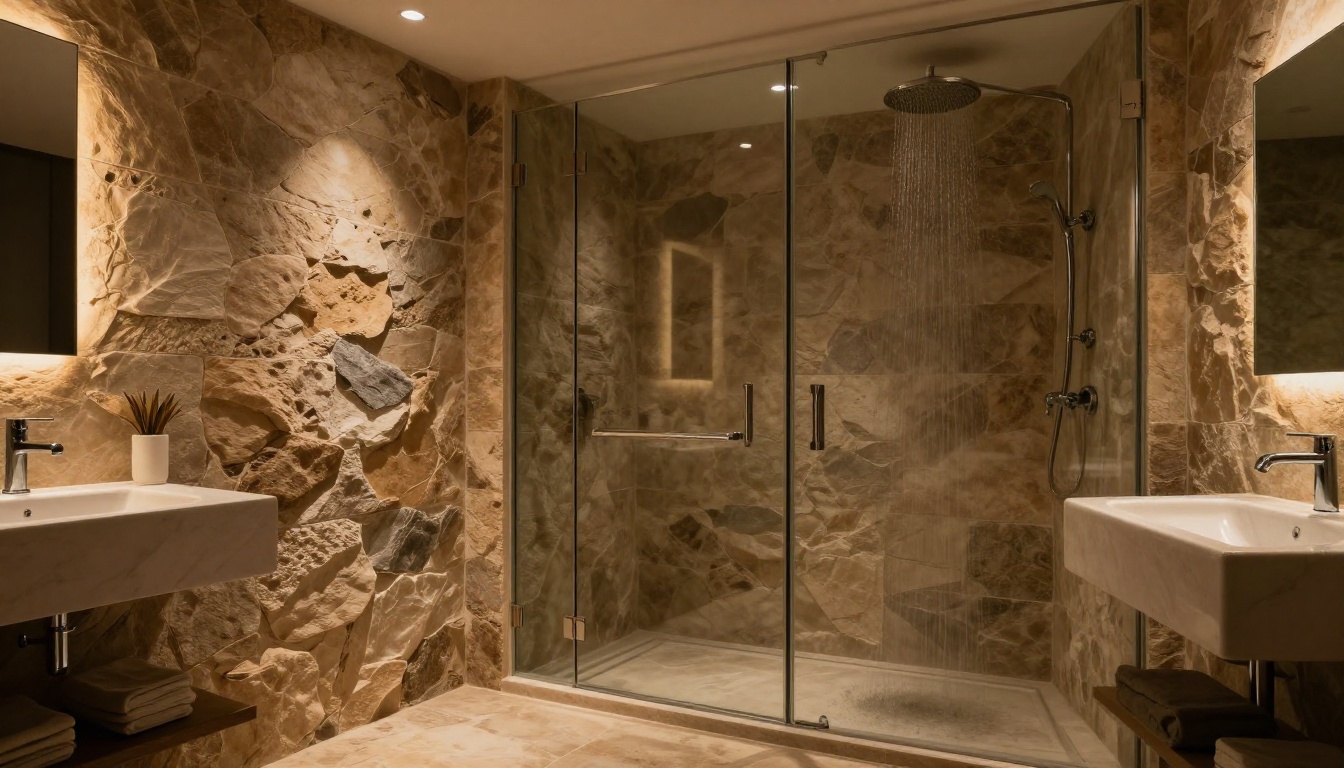
A $50,000 bathroom renovation sounds like a lot of money. It is a lot of money. But once you start pricing natural stone, quality fixtures, and competent labor, it becomes clear that this budget sits at the entry point of a genuinely high-end result — not at the ceiling. Here is an honest breakdown of where every dollar goes, what actually transforms the room, and what you can safely skip.
The Real Line Items: Where $50,000 Disappears
The single biggest misconception about bathroom renovations is that materials eat the budget. They don't. Labor does. In most major metros, skilled tradespeople — plumbers, electricians, tile setters, waterproofing specialists — will consume 40 to 50 percent of your total spend before a single slab of marble enters the room.
For a primary bathroom in the 80-to-120-square-foot range, here is a realistic allocation at the $50,000 level.
$50,000 Bathroom Renovation Budget Breakdown
| Category | Estimated Cost | % of Budget |
|---|---|---|
| Demolition & Labor | $20,000-$24,000 | 44% |
| Tile & Stone (material + installation) | $8,000-$12,000 | 20% |
| Fixtures (faucets, shower, tub) | $4,000-$6,000 | 10% |
| Vanity & Countertop | $3,000-$5,000 | 8% |
| Radiant Floor Heating | $1,500-$2,500 | 4% |
| Electrical & Lighting | $2,000-$3,000 | 5% |
| Glass Enclosure | $2,000-$3,500 | 5% |
| Permits, Design, Contingency | $2,000-$3,000 | 4% |
That contingency line is not optional. Every bathroom renovation uncovers something behind the walls — water damage, outdated wiring, subfloor issues. Budget 5 to 10 percent for surprises or you will be borrowing from your finish selections mid-project.
Stone: The Upgrade That Defines the Room
Nothing changes the character of a bathroom faster than the stone you choose. At this budget, you can afford genuine marble, quartzite, or large-format porcelain that mimics natural stone convincingly. You cannot afford to clad every surface floor-to-ceiling in Calacatta Gold — that alone could run $15,000 to $25,000 in material for a moderately sized room.
The smarter play is a considered mix. Use natural stone on the feature wall or shower surround, and pair it with a high-quality large-format porcelain (something like Fiandre or ABK) on the floor and remaining walls. A skilled tile setter can make this look intentional rather than compromised. The key is limiting the number of materials — two or three at most — so the room reads as deliberate.
Avoid the common mistake of choosing stone purely for visual drama. Carrara marble is beautiful but etches easily and requires sealing every six to twelve months. Quartzite is harder, more resistant, and often just as striking. For shower floors specifically, honed finishes outperform polished — they are less slippery and hide water spots.
Heated Floors: The Best Dollar-for-Dollar Upgrade
If you take one recommendation from this entire breakdown, it should be radiant floor heating. At $1,500 to $2,500 installed — including the thermostat and electrical work — it is the single highest-impact upgrade relative to cost. The system is embedded in thin-set beneath the tile, adds virtually no height to the floor, and lasts decades with zero maintenance.
Program it to warm up 30 minutes before your alarm. The difference between stepping onto cold tile and a gently heated floor is the kind of daily, tangible improvement that justifies renovation spending. It also keeps the bathroom drier, reducing mildew in grout lines.
One caveat: radiant heating works best under tile or stone. If you are set on wood-look plank flooring, the heat transfer is less efficient and some products will void their warranty over radiant systems. Confirm compatibility before committing.
Steam Showers: Worth It, but Not Cheap
A steam shower is the upgrade most people fantasize about and underestimate in cost. The generator itself runs $2,000 to $4,000 for a quality unit from Mr. Steam or ThermaSol. But the real expense is what the steam demands: the entire shower enclosure must be fully sealed, sloped correctly for condensation drainage, and built with a vapor barrier behind every surface. That means more labor, more waterproofing, and a proper ceiling (sloped, not flat, or you get cold drips on your head).
At a $50,000 total budget, a steam shower is achievable but requires trade-offs elsewhere — typically in fixture selection or stone coverage. If you are choosing between a steam shower and a freestanding tub, the steam shower delivers more frequent use for most people. Freestanding tubs photograph beautifully. They get used once a month.
Steam Shower vs. Freestanding Tub — Honest Comparison
| Factor | Steam Shower | Freestanding Tub |
|---|---|---|
| Typical Added Cost | $5,000-$8,000 | $3,000-$6,000 |
| Frequency of Use | Daily | 2-4x per month |
| Maintenance | Generator servicing every 2-3 years | Minimal |
| Space Required | Uses existing shower footprint | Needs 15-20 sq ft minimum |
| Resale Impact | Moderate | High (visual appeal) |
Fixtures: Where Diminishing Returns Hit Hard
This is where the market quietly separates informed buyers from everyone else. A Kohler Purist showerhead performs nearly identically to a Dornbracht unit costing four times as much. The finish quality differs — Dornbracht's chrome is denser, and their valves feel more precise — but the functional gap is narrow.
At the $50,000 level, allocate $4,000 to $6,000 for all fixtures: shower valve and trim, showerhead (rain plus handheld), faucet, and toilet. Brands like Kohler, Grohe, and Hansgrohe deliver at this range without compromise. Going beyond this — into Waterworks, Fantini, or CEA territory — is a choice about aesthetics and brand preference, not a meaningful step up in engineering.
The one fixture worth stretching for is the toilet. A wall-hung toilet with a concealed tank ( Geberit in-wall carrier is the industry standard) costs more to install but transforms the look and cleanability of the room. And if you have never used a bidet seat — Toto Washlet is the benchmark — it is the kind of upgrade that quietly ruins every other bathroom for you.
Lighting: Often an Afterthought, Always a Mistake
Bad lighting can undo $50,000 of renovation. The common error is a single overhead fixture that casts harsh shadows, making the room feel clinical. At a minimum, plan for three layers: ambient (recessed ceiling, dimmed), task (vanity sconces flanking the mirror at face height), and accent (a niche light in the shower or under-vanity LED strip).
Budget $2,000 to $3,000 for fixtures plus electrical work. Sconces at mirror height should be at 2700K to 3000K — warm enough to be flattering, bright enough to be functional. A dimmer on the overhead is non-negotiable.
What You Can Safely Skip
Television mirrors. They cost $3,000 to $5,000, the picture quality is mediocre through the glass, and the technology will be outdated in five years while the mirror itself should last thirty. A waterproof bluetooth speaker achieves 90 percent of the entertainment value for under $200.
Chromotherapy shower lights. The colored LED systems built into showerheads or steam units are a gimmick. They add cost, create another failure point, and nobody uses them after the first week.
Custom cabinetry for the vanity. A high-quality semi-custom vanity from a brand like Restoration Hardware, Waterworks (at their lower tier), or even a well-sourced vintage dresser conversion will look as good as full custom at half the price. The money saved goes further in stone or fixture quality.
The Honest Bottom Line
A $50,000 bathroom renovation, executed with discipline, produces a room that feels genuinely considered — not merely expensive. The upgrades that deliver daily, measurable improvement are heated floors, proper lighting, a quality shower system, and good stone. The upgrades that look impressive but underdeliver are freestanding tubs (for most people), TV mirrors, and top-tier fixtures beyond the mid-luxury tier.
The difference between a $50,000 bathroom and a $100,000 bathroom is almost entirely in material coverage and fixture branding, not in the bones. Get the layout right, invest in waterproofing and labor, and spend the remaining budget on the surfaces and fixtures you will touch every morning. That is where the money is felt.
Looking for luxury brands, stores, and services? Browse our curated directory: