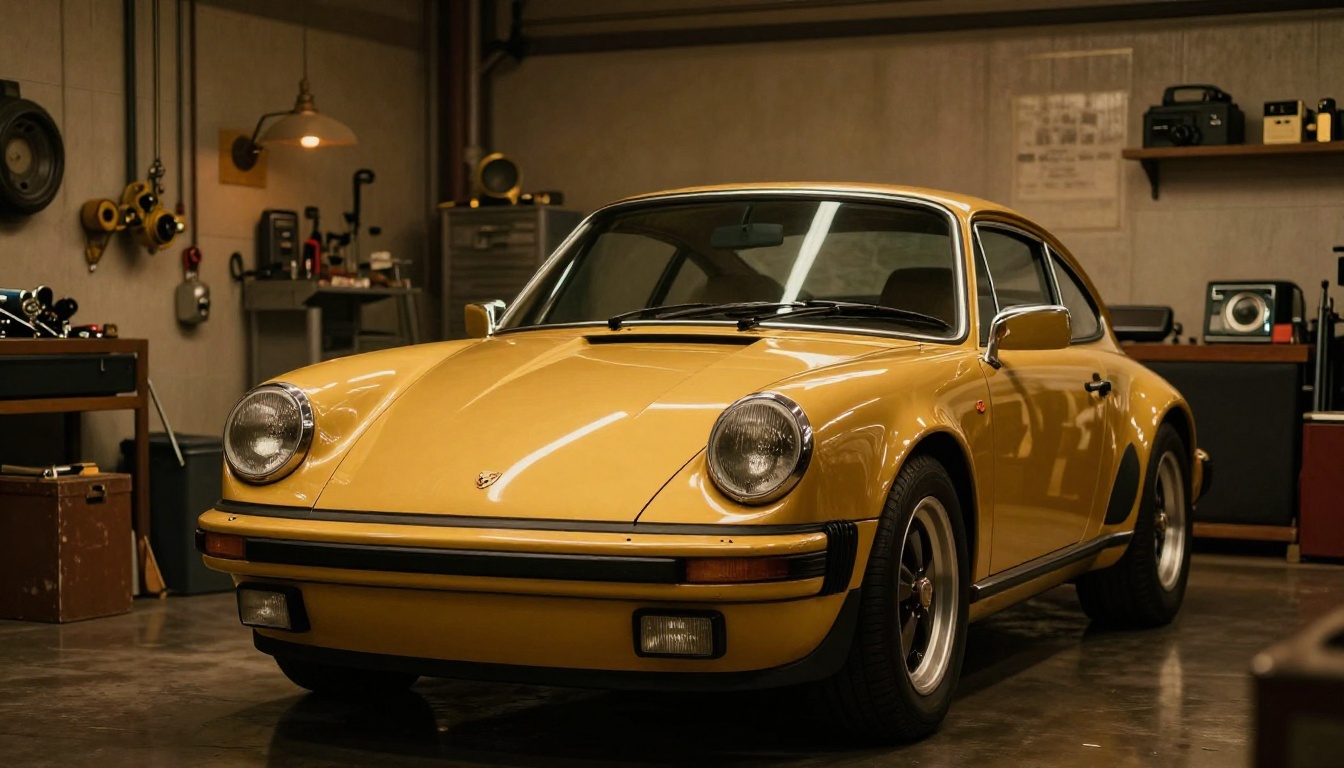
A 1973 Porsche 911 Carrera RS sold for $1.9 million at auction last year. The car before it on the block, a visually similar 911 T with a rebuilt engine and questionable panel gaps, went for $185,000. Both looked gorgeous under the auction lights. Only one was worth what someone paid for it.
The classic car market rewards knowledge and punishes enthusiasm. If you are considering buying your first collectible car, the gap between a smart purchase and an expensive mistake is wider than in almost any other category of high-value goods. Here is what the auction catalogs leave out.
The Matching Numbers Problem
"Matching numbers" is the most overused and least verified claim in the classic car world. It means the engine, transmission, and sometimes body panels carry serial numbers or date codes that correspond to the original factory build sheet. A matching-numbers car commands a significant premium, sometimes double or triple the price of an otherwise identical vehicle with replacement components.
The problem is verification. For many marques, factory records are incomplete, destroyed, or never existed in the format buyers assume. Porsche maintains relatively thorough archives. Ferrari does as well, through its Classiche certification program, which inspects and certifies originality for a fee of roughly $4,000-8,000. But for British cars, most American muscle cars, and many Japanese classics, provenance documentation is thin. Sellers know this, and the temptation to stamp correct-looking numbers onto replacement blocks is not theoretical. It happens.
Before paying a matching-numbers premium, demand documentation beyond the seller's word. A Porsche Certificate of Authenticity from Stuttgart. A Ferrari Classiche Red Book. For American cars, a Protect-O-Plate, broadcast sheet, or PHS documentation. If the seller cannot produce third-party verification, the premium is not justified.
Pre-Purchase Inspection Is Not Optional
An auction house will let you view a car, sometimes start it, occasionally drive it around a parking lot. What they will not do is put it on a lift, drop the undertray, scope the cylinders, or check for filler in the rocker panels. That costs money and slows the sale.
A proper pre-purchase inspection (PPI) by a marque specialist typically runs $500-1,500, depending on the car and the inspector's travel costs. This is not a general mechanic's once-over. It is a structured examination that should include compression and leak-down tests, a paint depth gauge reading across every panel, a structural inspection for previous crash damage and rust repair, and a detailed assessment of the electrical system.
For any car over $50,000, this is the single best investment you will make. For cars over $200,000, consider it mandatory. The inspection will not catch everything, but it will catch the most expensive surprises: hidden structural rust, a cracked block masked by stop-leak, frame damage that has been cosmetically repaired but not structurally corrected.
Pre-Purchase Inspection Essentials
| Check | What It Reveals | Approximate Cost |
|---|---|---|
| Paint depth gauge (full body) | Previous bodywork, filler, respray | Included in PPI |
| Compression and leak-down test | Engine internal condition | Included in PPI |
| Structural lift inspection | Rust, crash damage, frame integrity | Included in PPI |
| Marque specialist PPI | Overall mechanical and cosmetic assessment | $500-1,500 |
| Independent history check | Stolen, salvage title, lien status | $50-100 |
| Metallurgical testing (high-value) | Confirms original panels vs replacements | $1,000-3,000 |
The Real Cost of Ownership
The purchase price is the beginning, not the end. Classic car ownership carries ongoing costs that many first-time buyers underestimate, sometimes dramatically.
Storage. A proper climate-controlled storage facility runs $300-800 per month, depending on your market. Your garage may be fine if it is insulated, dry, and heated. If it is not, you are inviting condensation, rodent damage, and slow corrosion. Cars that sit for months without being run develop their own set of problems: flat-spotted tires, dried seals, stale fuel degrading carburetors or injection systems.
Insurance. Agreed-value policies from specialists like Hagerty or Grundy are essential. Standard auto insurance will pay you market value after depreciation, which for a classic car means a fraction of what you paid. Agreed-value policies cost $1,000-3,000 annually for most collectible cars in the $100,000-500,000 range, with the requirement that you maintain a separate daily driver and limit mileage.
Maintenance and repair. This is where costs become genuinely unpredictable. A routine service on a vintage Ferrari (oil change, fluid check, belt inspection) can run $2,000-4,000 at a specialist shop. A major service including timing belt or chain replacement on a V12 can exceed $15,000. Parts availability varies wildly by marque. Porsche air-cooled components are well-supported by aftermarket suppliers. Try sourcing NOS trim pieces for a 1960s Maserati and you will understand why some cars sit in shops for years.
Annual Ownership Costs by Price Bracket
| Car Value | Storage (annual) | Insurance | Routine Maintenance | Budget for Surprises |
|---|---|---|---|---|
| $50,000-100,000 | $2,400-6,000 | $800-1,500 | $1,000-3,000 | $2,000-5,000 |
| $100,000-300,000 | $3,600-9,600 | $1,500-3,000 | $2,000-6,000 | $5,000-15,000 |
| $300,000-1,000,000 | $6,000-12,000 | $3,000-8,000 | $5,000-15,000 | $10,000-30,000 |
Where the Smart Money Goes
The classic car market has distinct temperature zones. At the top, blue-chip collectibles from Ferrari, Porsche, and Mercedes-Benz have appreciated steadily for decades, but entry prices are already so high that future returns are uncertain. A 1960s Ferrari 275 GTB that sold for $200,000 in 2000 now trades above $3 million. Whether it reaches $6 million in the next twenty years is anyone's guess.
More interesting, and more accessible, are the segments where values have not yet been fully discovered. Air-cooled Porsche 911s from the 1970s and early 1980s, which were undervalued for decades, saw explosive growth between 2013 and 2020 and have since plateaued at levels that feel sustainable. The car that was $35,000 in 2012 is now $120,000-180,000 depending on variant and condition. That particular train has largely left the station.
Areas that still offer relative value include early water-cooled Porsche 996 and 997 models, which carry the 911 name without the air-cooled premium. Clean examples of the 996 Carrera can still be found for $30,000-50,000, and the 997.1 manual cars sit in the $50,000-80,000 range. Japanese sports cars from the 1990s, particularly the Toyota Supra (A80), Nissan Skyline GT-R (R32/R33), and Honda NSX, have already begun climbing but remain attainable compared to their European counterparts.
For a first classic car purchase, the most prudent approach is to buy the best example you can afford of a model with strong parts support and an active enthusiast community. A pristine, well-documented car at a fair price will almost always outperform a rough car bought cheaply with plans to restore. Restoration costs exceed purchase price with alarming regularity. A $40,000 car that needs $60,000 in work is not a $100,000 car when it is done. It is a $40,000 car that cost you $100,000.
Auction vs. Private Sale vs. Dealer
Each buying channel has trade-offs. Auctions offer the widest selection and the excitement of competitive bidding, which is precisely the problem. Buyer's premiums of 10-15% add significantly to the hammer price. The compressed timeline makes thorough inspection difficult. And the room's energy can push you past your predetermined limit in ways that feel rational in the moment and foolish the next morning.
Private sales offer the best prices but the least protection. There is no buyer's premium, and motivated sellers will negotiate. However, you bear the full burden of due diligence, and recourse if something is misrepresented ranges from difficult to impossible.
Specialist dealers charge a margin, typically 15-25% above what they paid, but the best ones stake their reputation on accurate descriptions, provide warranties on mechanical condition, and will take a car back if it is not as represented. For a first purchase, the dealer premium is often worth paying for the reduced risk.
The One Rule That Matters
Buy the car, not the story. Every classic car comes wrapped in narrative: the barn find, the celebrity owner, the racing provenance, the last-of-the-line special edition. Stories add value only when they are documented, verifiable, and relevant to what makes the car mechanically and historically significant.
A car with a complete service history, clear title, and verified originality from a seller who answers every question directly is worth more than a car with a better story and worse paperwork. The classic car market punishes impatience and rewards research. Take the time to learn the specific model you want, join the owner's forum, talk to the specialists, and inspect more cars than you think necessary before committing. The right car, bought correctly, is one of the more rewarding things you can own. The wrong car, bought hastily, is a hole you pour money into while it depreciates in your garage.
Looking for luxury brands, stores, and services? Browse our curated directory: