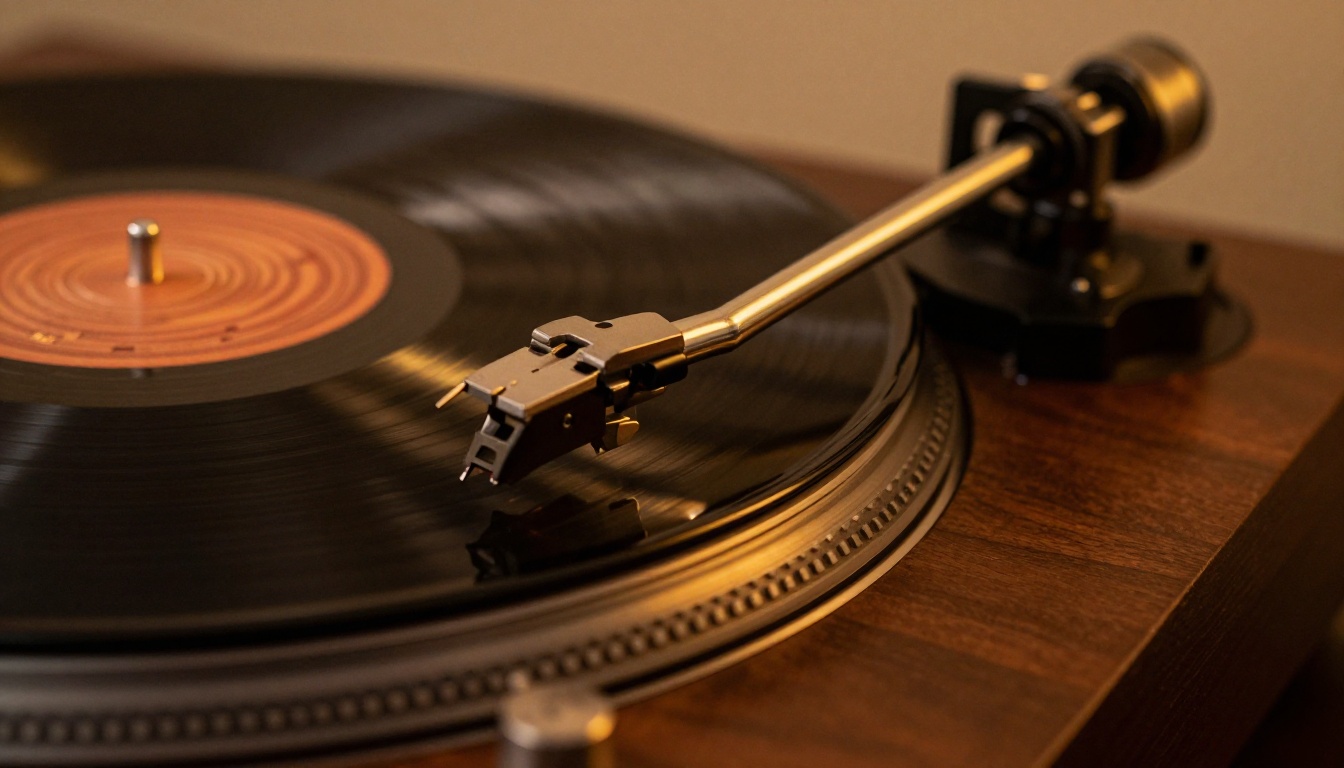
A $300 Audio-Technica turntable plays the same record as a $30,000 Linn LP12. Both spin a disc at 33 1/3 RPM. Both drag a diamond through a groove. The difference is what happens to the information trapped in that groove — how much of it reaches the air, and how much is lost to vibration, distortion, and compromise along the way.
The gap between a good turntable and a reference-grade one is not about volume or bass response. It is about resolution: the ability to hear the second violin section as individual players rather than a mass, or to detect the exact moment a singer takes a breath before the chorus. That kind of retrieval requires every component in the chain to be doing its job with minimal interference. Getting there is expensive — but not every dollar carries equal weight.
The Hierarchy: Where Money Matters Most
Audiophiles debate endlessly about which component matters most. The engineering consensus, confirmed by decades of testing and the experience of dealers who set up systems for a living, follows a clear hierarchy: cartridge first, phono stage second, turntable third, tonearm fourth, cables last. Most people get this backwards, spending the bulk of their budget on the turntable itself and treating the cartridge as an afterthought.
The logic is straightforward. The cartridge is the only component that touches the record. It is the transducer — the device that converts mechanical vibration into an electrical signal. Every flaw it introduces, every detail it misses, is gone forever. No downstream component can recover information the cartridge failed to extract.
Component Priority: Where Each Dollar Has the Most Impact
The phono stage amplifies the tiny signal from the cartridge — often less than half a millivolt for a moving-coil design — and applies the RIAA equalization curve that every record is cut with. A mediocre phono stage adds noise and compresses dynamics at this critical amplification stage. The turntable's job, meanwhile, is essentially negative: spin at a constant speed and add nothing. No vibration, no resonance, no speed variation. The best turntables are the ones that interfere the least.
What Each Price Tier Actually Delivers
The gains from spending more on a vinyl rig follow a logarithmic curve. The jump from $500 to $5,000 is transformative. From $5,000 to $15,000, the improvements are real but more refined. Beyond $15,000, the returns diminish sharply — though for the right ears in the right room, they remain audible.
Turntable Tiers: What the Money Buys
| Tier | Budget | Turntable | Cartridge | Phono Stage | What You Gain |
|---|---|---|---|---|---|
| Entry Serious | $3,000-$5,000 | Rega Planar 6 | Rega Ania MC | Rega Aria | Rhythmic coherence, clean tracking |
| Committed | $8,000-$15,000 | Linn LP12 Majik | Dynavector XX-2 Mk II | Linn Linto / Sutherland 20/20 | Spatial depth, instrument separation |
| Reference | $20,000-$50,000 | Clearaudio Innovation | Lyra Etna SL | Pass Labs XP-27 | Micro-detail, holographic imaging |
| Statement | $50,000+ | TechDAS Air Force III | Lyra Atlas SL / Koetsu Coralstone | Boulder 2108 | Last-percent resolution, vanishing noise floor |
The $5,000 System
At this level, a Rega Planar 6 with the matching Ania moving-coil cartridge and Aria phono stage represents a considered, well-integrated package. Rega designs its turntables, arms, and cartridges to work as a system — an approach that minimizes the compatibility issues that plague mix-and-match setups at this price. The result is a turntable that times well, tracks accurately, and reveals enough detail to make the case for vinyl over streaming without qualification.
The trade-off: limited upgrade path. Rega's philosophy is to buy the best complete system you can afford rather than upgrade piecemeal. That is philosophically sound but commercially inconvenient if the upgrade itch hits.
The $15,000 System
The occupies a unique position in hi-fi. Introduced in 1973, it has been continuously refined for over fifty years — a track record no other turntable matches. The Majik-level LP12 (around $7,000-$8,000 with arm) paired with a Dynavector XX-2 Mk II cartridge ($2,500) and a quality phono stage like the Sutherland 20/20 ($3,000) produces a system with genuine spatial depth. Instruments occupy distinct positions in the soundstage, and the leading edges of notes — the initial attack of a piano hammer, the pluck of an upright bass string — arrive with convincing speed.
The LP12's modular design means every sub-component can be upgraded over time: power supply, sub-chassis, bearing, arm board. This makes it a long-term platform rather than a fixed product — closer to a mechanical watch that gets serviced and improved than to consumer electronics with a built-in expiration date. Dealers who specialize in LP12 setup, such as those trained through Linn's own certification program, are essential. A poorly set up LP12 sounds worse than a turntable at half the price.
The $30,000+ System
At reference level, the and the represent two philosophically different approaches to the same problem. Clearaudio uses magnetic bearing technology to float the platter with zero physical contact — eliminating bearing noise entirely. TechDAS uses a vacuum hold-down system that sucks the record flat against the platter, removing the warps and imperfections that cause the stylus to misbehave. Both work. Both cost accordingly.
Paired with a Lyra Atlas SL cartridge ($13,000) or a Koetsu Coralstone ($10,000+) and a phono stage from Pass Labs or Boulder, these systems produce sound with a vanishing noise floor and the kind of three-dimensional imaging that can genuinely startle. The cello on a well-pressed Jacqueline du Pre recording does not come from two speakers — it occupies a specific point in the room, with body and resonance.
The difference between a $5,000 system and a $30,000 system is not that one sounds good and the other sounds better. The cheaper system sounds like a good recording. The expensive system sounds like musicians in a room.
The Cartridge Question
No single component has more influence on what a turntable system actually sounds like than the cartridge. Moving-magnet cartridges (the type included with most turntables under $2,000) are robust and easy to use but limited in their ability to track fine groove detail. Moving-coil designs flip the physics: a lighter moving element means faster response and finer resolution, but the output voltage drops dramatically, demanding a more capable (and expensive) phono stage.
Cartridge Price vs. Tracking Ability
The tracking ability chart reveals why cartridge spending matters disproportionately. The jump from an Ortofon 2M Red ($100) to a Rega Ania ($650) is enormous in terms of what the stylus retrieves from the groove. The jump from a Dynavector XX-2 to a Lyra Kleos is subtler but still clearly audible — particularly on complex orchestral passages where cheaper cartridges begin to smear individual instruments together. Beyond the Etna, the gains are real but increasingly marginal: the Atlas SL extracts perhaps five percent more information than the Etna, and only a carefully treated room and dead-quiet electronics will let that difference be heard.
Cartridge life is another consideration. A quality diamond stylus on a moving-coil cartridge lasts approximately 1,500-2,000 hours before needing a retip or replacement. On a $13,000 cartridge, that means the cost of playing records is roughly $7-$9 per hour of listening — a figure that makes vinyl an intentional, deliberate hobby rather than a casual one.
The Components That Define a Reference Setup
Beyond the turntable-cartridge-phono stage core, several components and practices separate serious rigs from merely expensive ones.
- Tonearm geometry — The tonearm must hold the cartridge at precise alignment across the entire record surface. SME's Model V tonearm (around $5,500) has been a reference standard for decades, using a magnesium armtube and fluid damping to control resonance. Linn's Ekos SE and Clearaudio's TT5 offer alternatives at similar or higher price points. Arm-cartridge matching — ensuring the compliance and mass are compatible — matters as much as the quality of either component alone.
- Isolation and support — Turntables are microphones for floor vibrations. A quality isolation platform — Finite Elemente, HRS, or Symposium — can improve the performance of any turntable by reducing the mechanical noise that reaches the stylus. Budget $1,000-$5,000 for proper isolation; it is not a luxury add-on, it is a necessity at this level.
- Phono cable — The cable between tonearm and phono stage carries a signal measured in microvolts. Capacitance and shielding matter here more than in any other cable run in a hi-fi system. This is the one place where cable quality makes a measurable, repeatable difference — unlike speaker cables, where the claims routinely outstrip the physics.
- Record cleaning — A $30,000 cartridge tracking a dirty record sounds worse than a $500 cartridge tracking a clean one. Ultrasonic record cleaning machines (Degritter, Audio Desk Systeme) run $2,000-$4,000 and are non-negotiable for anyone serious about vinyl playback. The improvement is not subtle.
The Honest Trade-Offs
High-end vinyl playback is not convenient. Records need cleaning, cartridges need alignment, styli wear out, and the format itself carries inherent limitations — a 45dB signal-to-noise ratio versus 96dB or better from digital, and frequency response that rolls off at the extremes. Anyone claiming vinyl is technically superior to well-implemented digital is either selling something or not reading the spec sheet.
What vinyl does offer at this level is a different kind of engagement. The ritual of cleaning a record, cueing the stylus, and sitting for an uninterrupted album side creates a mode of listening that streaming has largely eliminated. The analog signal path — with its gentle harmonic distortion and natural compression — produces a presentation that many listeners find more involving than digital's clinical accuracy, even when digital resolves more actual detail. This is a legitimate preference, not an objective superiority. Knowing the difference matters.
There is also the question of diminishing returns. The difference between a well-chosen digital streaming setup at $5,000 and a vinyl rig at $30,000 is not the kind of gap that justifies itself on sound quality alone. It justifies itself on the experience of listening — the intentionality, the physicality, the engagement with a medium that demands attention. For some listeners, that is worth every dollar. For others, a Roon-based digital system delivers better sound for less money with none of the maintenance. Both positions are defensible.
Where to Start
The smartest entry into serious vinyl is not a statement turntable with a mediocre cartridge. It is a solid turntable with the best cartridge and phono stage the budget allows. A Rega Planar 8 or a Linn LP12 at the Majik level, paired with a cartridge that punches above the turntable's price class, will outperform a system where the budget ratio is inverted.
Find a dealer who will demonstrate the difference between cartridge tiers on the same turntable — this is the single most persuasive experience in hi-fi, and any serious dealer will accommodate it. Listen to the same pressing with a $500 cartridge and a $2,500 cartridge. The turntable, arm, phono stage, amplifier, and speakers remain identical. If the difference is not immediately obvious, vinyl at this level may not be the right pursuit. If it is — if the $2,500 cartridge reveals instruments and textures the $500 one was hiding — the hierarchy is proven, and the upgrade path becomes clear.
The parallel to independent watchmaking is deliberate. Both communities value craft over convenience, mechanical precision over digital efficiency, and the subjective experience of engaging with a physical object. A $30,000 turntable, like a $30,000 watch, does not do anything a cheaper alternative cannot. What it does, it does with a level of refinement that rewards sustained attention. Whether that refinement is worth five figures is a question only the listener — sitting in a treated room, needle in groove, album side one playing uninterrupted — can answer.