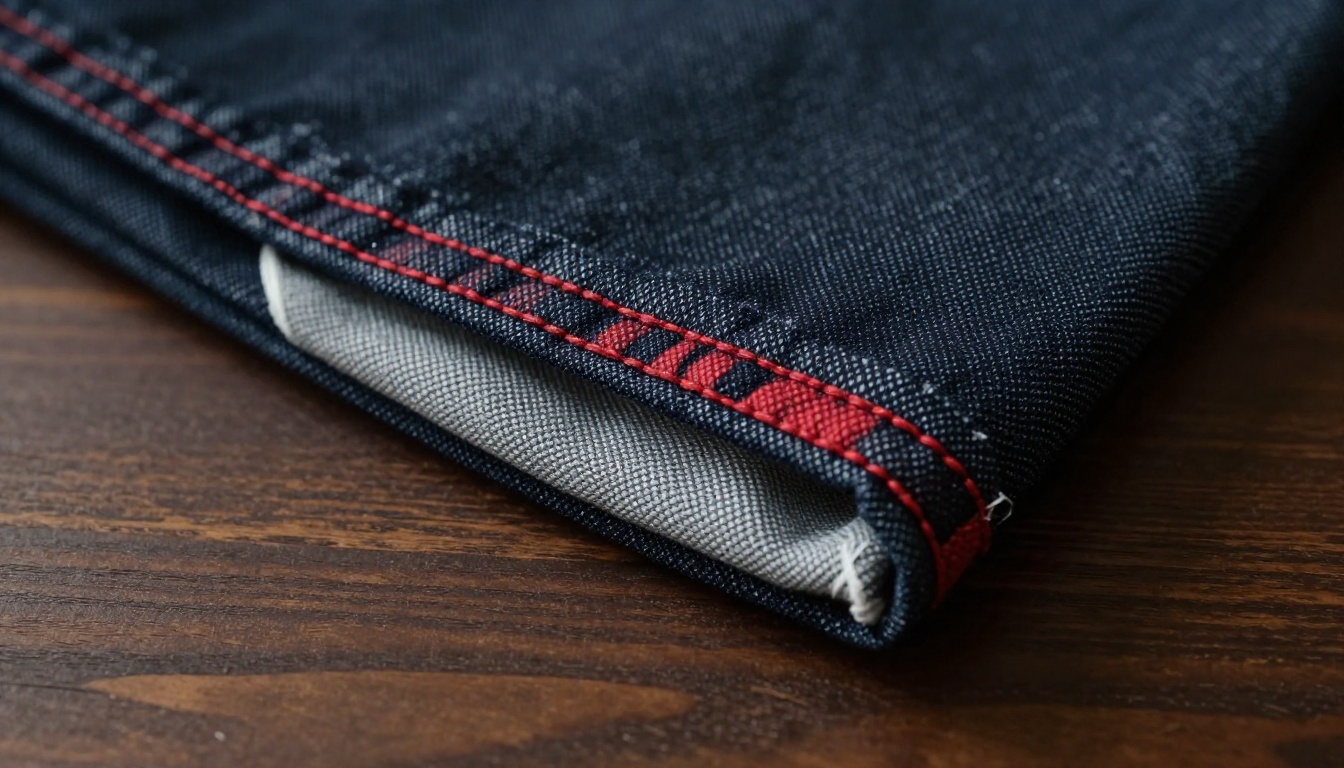
A pair of raw selvedge jeans from Momotaro costs roughly seven times more than a pair of Levi’s 501s. Both are blue. Both are cotton. Both will fade, soften, and eventually develop holes in the knees. The difference is in how they get there — and what happens along the way.
Japanese denim has attracted a devoted following since the 1990s, when small mills in Okayama and Hiroshima prefectures began weaving fabric on vintage shuttle looms that American manufacturers had discarded decades earlier. That following has grown steadily louder in recent years, driven partly by a broader cultural turn toward craft and durability, and partly by the undeniable reality that these jeans age unlike anything else on the market.
The Mills: Where the Fabric Begins
Japanese selvedge denim starts at the mill, and three names dominate the conversation. Kuroki Mills, based in Ibara, Okayama, supplies denim to brands ranging from Tom Ford to The Flat Head. Collect Mills, also in Okayama, specializes in heavyweight and irregular-textured fabrics. Kaihara, operating out of Hiroshima prefecture since 1893, is the largest — producing for Levi’s Japan, Uniqlo’s premium selvedge line, and several European fashion houses.
What sets these mills apart is not just the equipment but the approach. Shuttle looms weave fabric slowly — roughly 15 meters per hour compared to 90 or more on modern projectile looms. The resulting fabric has a tighter, denser weave at the selvedge edge, and a subtle irregularity in the surface texture that mass-produced denim cannot replicate. This irregularity is the point. It produces the vertical fading patterns — called “slub” — that raw denim enthusiasts prize.
Rope Dyeing, Indigo, and Why Fading Matters
The color of a pair of jeans is not as simple as it looks. Premium Japanese denim uses rope dyeing: yarns are twisted into ropes, dipped repeatedly through indigo vats, and oxidized between each pass. The number of dips — anywhere from four to sixteen — determines the depth of color. More dips mean a darker starting shade and more dramatic contrast as the dye wears away.
This is fundamentally different from the sheet dyeing or sulfur dyeing used for most mass-market denim. Rope-dyed indigo penetrates only the outer layers of each yarn, leaving the core white. As the jeans are worn, the outer indigo gradually wears off at stress points — the lap, the back of the knees, the pocket edges — revealing the white core underneath. This creates the high-contrast fading that defines well-aged raw denim.
The fades on a pair of raw selvedge jeans are, in a literal sense, a record of how the wearer moves. No two pairs age the same way.
Cheaper denim skips this process entirely, or uses synthetic indigo with fewer dips. The result is flat, uniform fading — if it fades at all. Many sub-$100 jeans are pre-washed or enzyme-treated to simulate worn-in character, which eliminates the possibility of developing genuine patina over time.
Construction: Where the Price Difference Lives
Fabric accounts for perhaps 30-40% of the cost difference between a $60 and a $400 pair of jeans. The rest is construction. The details that separate a well-made pair from a commodity product are specific and measurable.
Construction Comparison: Mass-Market vs. Premium Japanese Denim
| Feature | $50-80 Jeans | $200-350 Japanese Selvedge | $350-500+ Heritage Japanese |
|---|---|---|---|
| Stitching | Single-needle on outseam | Chain-stitch hem, single-needle outseam | Chain-stitch throughout, hidden rivets |
| Rivets | Stamped, plated base metal | Copper or iron, branded | Hand-set copper, custom-cast |
| Buttons | Snap-on, generic | Cast metal, branded | Custom-milled, often iron |
| Pocket Bags | Thin polyester blend | Cotton drill or herringbone | Heavy cotton, sometimes hand-sewn |
| Selvedge | None (open-end weave) | Standard selvedge ID | Colored selvedge ID, mill-specific |
| Thread | Polyester core | 100% cotton or poly-core | Pure cotton, sometimes hand-dyed |
The chain stitch deserves particular attention. A chain-stitch hem — produced on a Union Special 43200G or equivalent vintage machine — creates a distinctive roping effect as the jeans fade. The stitch allows the fabric to bunch slightly, producing the horizontal lines of wear at the cuff that selvedge collectors photograph obsessively. A lockstitch hem, standard on most jeans, lies flat and produces no such effect. The difference is invisible on day one and unmistakable at month six.
The Brands Worth Knowing
Japanese denim brands fall roughly into three tiers, each with a distinct philosophy and price band.
Entry-Level Selvedge: $120-200
Japan Blue and Uniqlo Selvedge sit here. Japan Blue, produced by the same parent company as Momotaro (Collect Inc.), uses Collect Mills fabric but with simpler construction and fewer hand-finished details. Uniqlo’s selvedge line, woven by Kaihara, is arguably the most accessible entry point — the fabric is genuine, the construction is decent, and the price ($50-80 during promotions) is remarkably low. The trade-off is in details: generic hardware, lockstitch hems, and limited fit options.
Core Japanese Selvedge: $200-400
This is where most of the serious brands operate. produces some of the most recognizable Japanese denim, identifiable by its distinctive battle stripes painted onto the back pocket. The flagship 0105SP uses 15.7 oz. Zimbabwe cotton denim woven in-house at Collect Mills. , founded in 1979, was among the first to revive vintage American denim styles in Japan and remains known for its pig-skin leather patch and aggressive slubby textures.
Pure Blue Japan occupies a similar tier but with a wilder aesthetic — heavy slub, irregular dyeing, and textures that look almost handwoven. The Flat Head takes a more structured approach, combining Kuroki Mills fabric with meticulous hardware sourced from small Japanese metalworkers.
Ultra-Premium: $400-700+
defines this tier. Founded in 2003 by Haraki Goro, the brand is known for heavyweight denim that starts at 21 oz. and goes up to a punishing 25 oz. — roughly the weight of light upholstery fabric. sources from multiple mills including Kuroki and uses proprietary weaves. The jeans are built to last years of hard daily wear, and owners report that the break-in period alone can take three to six months. Samurai Jeans, based in Osaka, also operates at this level, using a proprietary blend of Texas and Zimbabwe cotton that produces a distinctively hairy, textured surface.
Price Range by Brand (Flagship Models)
Denim Weight: What the Numbers Mean
Denim weight, measured in ounces per square yard, is one of the most discussed metrics in the raw denim community — and one of the most misunderstood. Heavier is not inherently better. It simply means a different wearing experience.
Denim Weight Guide
| Weight | Feel | Break-In | Best For |
|---|---|---|---|
| 10-12 oz. | Light, soft from day one | Minimal | Warm climates, casual wear |
| 13-14 oz. | Medium, standard Levi’s weight | 2-4 weeks | Year-round daily wear |
| 15-17 oz. | Substantial, structured | 1-3 months | Dedicated raw denim wearers |
| 18-21 oz. | Heavy, stiff initially | 3-6 months | Enthusiasts, cooler climates |
| 21+ oz. | Armor-like when new | 6+ months | Collectors, Iron Heart devotees |
Most newcomers to Japanese selvedge are best served in the 13-16 oz. range. The fabric is heavy enough to develop defined fades but light enough to be comfortable year-round. The 21 oz.+ category is a commitment — wearers describe the first month as genuinely uncomfortable, with the fabric softening gradually through repeated wear. The payoff, for those who persist, is a depth of fade and a structural integrity that lighter denim cannot match.
Typical Denim Weight by Brand (oz.)
The Diminishing Returns Question
It would be dishonest to pretend that the gap between a $350 pair and a $530 pair is as meaningful as the gap between $60 and $350. It is not. The jump from mass-market to Japanese selvedge represents a genuine leap in fabric quality, construction, and aging potential. The jump from mid-tier Japanese selvedge to the ultra-premium tier is about refinement, not transformation.
At the $200-350 level, buyers get shuttle-loom selvedge fabric, rope-dyed indigo, chain-stitch hems, quality hardware, and a pair of jeans that will age dramatically over years of wear. Above $350, the improvements are incremental: proprietary cotton blends, heavier weights, more hand-finishing, better leather patches, and the kind of hardware obsessiveness — custom-cast buttons, hand-hammered rivets — that only a small audience appreciates.
The parallel to other craft categories is direct. The same dynamic applies to premium textiles generally: a clear quality threshold exists, above which additional spending buys subtlety rather than substance. A reader who has explored the economics of a high-end cashmere coat will recognize the pattern. The question is whether those subtleties matter to the buyer.
Raw Denim Care: Less Is More
The care instructions for raw selvedge denim are simple and often controversial: wash as infrequently as possible for the first six months, then cold soak or gentle machine wash inside-out. Some purists advocate never washing; most serious brands recommend the first wash at six months of wear to set the fades.
- First six months — Wear daily. Spot-clean stains. Air out overnight. The goal is to set crease patterns that will become permanent fade lines.
- First wash — Cold soak in a bathtub for 45 minutes, or gentle cold cycle inside-out. No detergent, or a capful of specialized denim wash. Hang dry only.
- Ongoing — Wash every 2-3 months at most. Each wash softens the contrast between faded and unfaded areas, so frequency is a trade-off between hygiene and visual impact.
- Never — Hot water, tumble drying, bleach, or dry cleaning. All will destroy the indigo and compromise the fabric.
The unwashed approach is not for everyone, and those uncomfortable with it should not feel obligated. A pair of Japanese selvedge washed monthly will still age far more attractively than pre-washed mass-market denim. The six-month guideline maximizes contrast but is not the only valid approach.
What $400 Jeans Actually Get You
Strip away the enthusiasm and the heritage storytelling, and the case for Japanese selvedge denim comes down to three tangible things. First, fabric that ages rather than deteriorates — developing character over years instead of pilling, stretching, and fading to a uniform gray. Second, construction details that extend the life of the garment to five, eight, or ten years of regular wear, where a mass-market pair is typically done at eighteen months. Third, a fit and feel that improves with time rather than declining.
The craft argument matters too, in the same way it matters for hand-cut Italian suits or handmade English shoes. These are garments produced on machinery that is deliberately inefficient because the results are measurably different. The shuttle looms at Kuroki and Collect run slowly not for romance but because the fabric they produce has a structural quality that modern looms do not replicate.
Whether that justifies $400 depends on how the buyer values craft, durability, and the slow accumulation of something personal on a piece of clothing. For those who do, the entry point has never been more accessible — and the long-term cost per wear often works out lower than buying disposable alternatives every year.