Savile Row gets the magazine covers, the Bond films, and the mythology. But if you ask the people who actually spend their lives inside tailored clothing — the dealers, the diplomats, the men who own forty suits and wear them all — most will tell you the same thing. The best suits in the world come from Naples.
This isn't contrarianism. It's a matter of philosophy. English tailoring builds a suit like armor: heavy canvas, padded shoulders, a defined waist that shapes the body into a silhouette. Neapolitan tailoring builds a suit like a second skin. The jacket is soft, unlined or half-lined, with no padding and a shoulder that rolls naturally into the sleeve. The Italians call it "spalla camicia" — shirt shoulder. The result is a suit that looks structured from across the room but feels like a cardigan when you put it on.
The Neapolitan Tradition: Why Construction Matters
What separates a Neapolitan suit from everything else is how it's built. In London, a jacket is constructed on a mannequin — the canvas and padding do much of the structural work. In Naples, the jacket is built directly on the client's body. The tailor uses his hands to press, shape, and ease the cloth into a garment that follows the wearer's posture, not an idealized version of it.
The soft construction means no chest piece stiffening the front, minimal lining so the jacket breathes in Mediterranean heat, and a high armhole that allows full range of motion. You can raise your arms in a well-made Neapolitan jacket and the body barely moves. Try that in a Savile Row coat and you'll feel the entire garment pulling upward.
This demands more skill, not less. Without padding and canvas to provide structure, every line depends on the cut and the stitching. There's nowhere to hide a mistake. The best Neapolitan tailors carry thirty or forty years of hand knowledge — the instinct for how a particular cloth will behave when shaped, steamed, and pressed.
The Houses Worth Knowing
Naples has dozens of tailoring workshops, but five houses consistently produce work that justifies traveling to southern Italy with a blank check and an open calendar.
Kiton: The Scale of Perfection
Kiton is the most commercially visible Neapolitan house, with boutiques worldwide and suits retailing from $7,000 to $25,000. More than fifty tailors work on a single suit, each specializing in one operation. Twenty-five hours of handwork go into every jacket. CEO Antonio De Matteis oversees a factory that is really a workshop scaled up without compromising the handwork. If you want Neapolitan construction without flying to Naples, Kiton is the most reliable entry point at the top of the market.
Cesare Attolini: The Family That Started It All
If one house can claim to have invented Neapolitan tailoring as we know it, it's Attolini . Vincenzo Attolini created the soft, unstructured shoulder in the 1930s, breaking with the rigid Anglo-Italian style that dominated at the time. His grandson Massimiliano runs the house today with fewer than a hundred employees, no advertising budget, and a client list built entirely on word of mouth. Suits range from $5,000 to $15,000. Attolini is the thinking person's choice — the house that people discover after they've already owned suits from everywhere else.
Isaia: The Modernizer
Run by Enrico Isaia, this is the house that brought Neapolitan tailoring into the 21st century. The construction is traditional — soft shoulder, hand-stitched buttonholes, unlined or half-lined — but the design is contemporary. Slimmer cuts, fashion-forward fabrics, a willingness to experiment with color and pattern that more conservative houses avoid. At $4,000 to $8,000, Isaia is also the most accessible price point for genuine Neapolitan work. For someone under forty buying their first serious suit, this is often the right door to walk through.
Rubinacci: The Theatre of Tailoring
Rubinacci does everything at the highest possible level and charges accordingly, starting at around five thousand euros and climbing well past twenty thousand. Mariano and his son Luca run the operation, and Luca has become as much the product as the suits — a walking advertisement for Neapolitan ease. Their "London House" model brings fittings to international clients: three appointments, six to eight weeks, a finished suit that arrives with the confidence of generational craft. If you want the full experience — the storytelling, the sense that you're participating in a tradition — Rubinacci delivers it.
Sartoria Dalcuore: The Insider's Secret
Every world has its hidden gem, and in Neapolitan tailoring it's Dalcuore. A smaller operation with no marketing presence, no social media strategy, and no interest in becoming the next Kiton. What they have is extraordinary hand-stitching, a deep understanding of soft construction, and prices that start around three thousand euros — a fraction of what the bigger names charge for comparable work. Booking a fitting usually requires knowing someone, or at least showing up in Naples with a credible introduction. The difficulty of access is part of the appeal.
The best Neapolitan tailors don't ask what style you want. They watch how you stand, how you move, how you carry your weight. The suit is built from observation, not from a pattern book. That's why a first fitting in Naples takes an hour, not fifteen minutes.
The Fabric: What You're Actually Choosing
Regardless of which house you commission from, the fabric conversation follows a similar pattern. Neapolitan tailors source from the same elite mills: Loro Piana, Vitale Barberis Canonico, Holland and Sherry, and Scabal. The quality is uniformly excellent. The real decision is about weight, weave, and the Super number.
The Super number — Super 100s, 120s, 150s — indicates the fineness of the wool fiber. Higher numbers mean finer, softer cloth. But finer isn't always better. Super 120 to 130 is the sweet spot for a suit you'll wear regularly. The fabric has enough body to drape well, enough resilience to resist creasing, and enough durability to last years with proper care. Super 150 and above produces a beautiful hand feel and an almost liquid drape, but it creases more easily and wears out faster. Reserve those for special-occasion suits, not your daily rotation.
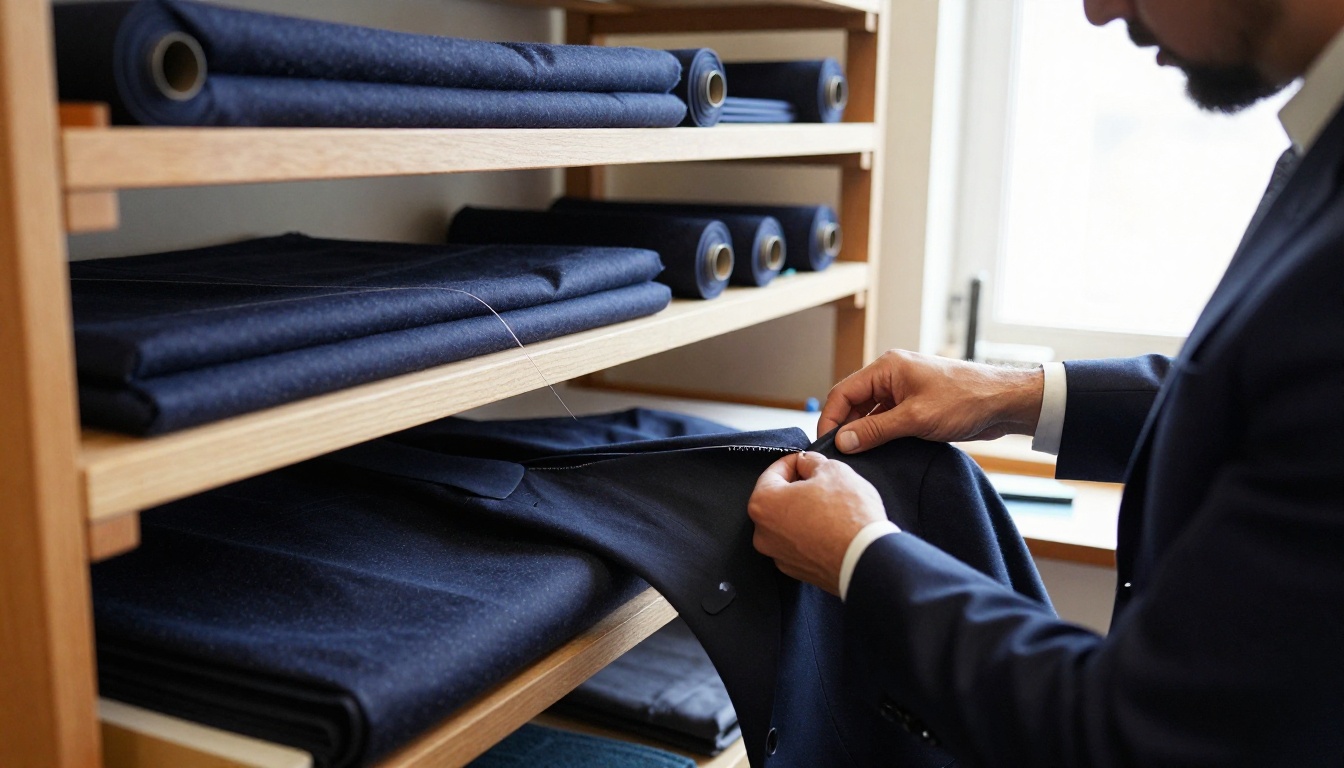
For a first commission, most tailors will steer you toward a navy or charcoal in a plain weave or a subtle twill. This isn't a lack of imagination. It's professional advice. A solid navy suit in Super 120 wool is the most versatile garment a man can own. It works with a white shirt and black shoes for formal settings, with a knit polo for dinners, and even without a tie for most business environments. Master the foundation before you start experimenting with windowpanes and houndstooth.
How to Commission Your First Neapolitan Suit
The process begins with contact. Kiton and Isaia have retail locations in major cities. For Rubinacci, Attolini, and Dalcuore, email the house directly or visit Naples in person. Via Chiaia is the street — a narrow road in the Chiaia district where several of the best workshops sit within walking distance of each other.
The first fitting is the longest and most important. The tailor takes measurements — dozens of them, far more than any off-the-rack sizing system captures. Then comes fabric selection from bolts and swatch books. Finally, the style discussion: two-button or three-roll-two? Peak lapel or notch? Pleated trousers or flat-front? Ticket pocket or no? Working buttonholes on the sleeve? Each choice has implications for formality, proportion, and how the finished suit will read in context.
The second fitting, typically four to six weeks later, is where you see the suit for the first time — basted together with loose stitching, the fabric pinned and chalked where adjustments are needed. This is the most revealing moment. You can see the shape of the jacket, feel how the shoulder sits, check whether the chest drapes cleanly or pulls. Changes are made on the spot. The third fitting is near-final: the suit is fully constructed, and only minor tweaks remain. Delivery follows in one to three weeks after that.
A properly commissioned Neapolitan suit takes three fittings and six to twelve weeks. There are no shortcuts. If a house promises faster turnaround, they are cutting corners — either with the handwork or with the fitting process. Both will show in the finished garment.
Naples vs. London vs. Rome: Choosing Your Tradition
The question isn't which tradition is "best." It's which one matches your life. Savile Row wins on structure and formality — if you need suits for boardrooms, courtrooms, or state occasions, English tailoring provides the authority. Padded shoulders and heavy canvas create a commanding silhouette that projects seriousness.
Naples wins on comfort and versatility. The soft construction works equally well with a tie or without one, in a meeting or at a restaurant, in January or July. For the way most successful men actually dress today — professional but not rigid, considered but not stiff — Neapolitan tailoring is the more practical choice.
Rome occupies the middle ground. Houses like Brioni and Caraceni combine Italian fabrics and style with more structure than Naples, producing suits that split the difference between English formality and Neapolitan ease. It's a valid choice, though purists on both sides tend to see it as a compromise rather than a synthesis.
For a first commission, Neapolitan construction is the recommendation. Modern dress codes have moved decisively toward comfort and away from rigidity. A suit that feels like a cardigan and looks like it was cut by a master — that's not a compromise. That's the point.
Looking for luxury brands, stores, and services? Browse our curated directory: