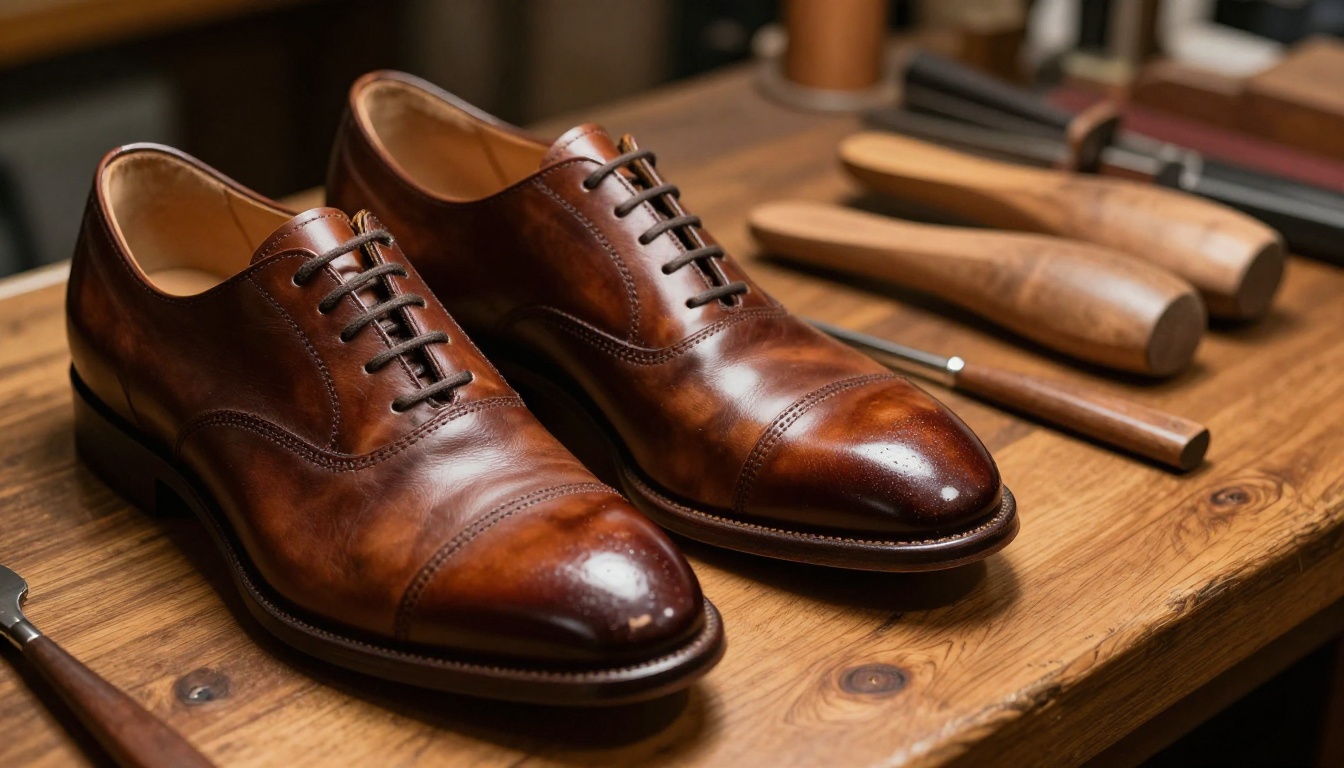
A pair of hand-welted shoes from Northampton or Paris takes between 150 and 250 hours to make. The leather is cut by hand, the uppers are closed by hand, and the sole is attached not with glue or a machine but with a continuous thread of linen or hemp, stitched through a channel carved into the sole by a single craftsman. The result is a shoe that can be resoled five, six, even seven times over decades. That alone is worth understanding before you spend anything.
The question is not whether handmade shoes are good. They are, categorically. The question is where the money actually goes at each price tier, and whether a six-month wait for a fully bespoke pair delivers proportional value over a ready-to-wear shoe from the same maker at a fraction of the cost.
What Hand-Welted Construction Actually Means
Most shoes sold as "premium" today use a Goodyear welt, a machine process invented in the 1870s that mimics hand welting. A Goodyear-welted shoe is a solid product. But a hand-welted shoe is structurally different in ways that matter over time.
In hand welting, the shoemaker carves a holdfast ridge from the insole itself, then stitches the welt directly to this ridge and the upper in one continuous pass. The result is a thinner, more flexible sole construction that moulds to the wearer's foot more completely. There is no gemming strip, no synthetic reinforcement. The insole is a single piece of oak-bark-tanned leather, typically 4-5mm thick, that develops a footprint over months of wear.
This is why a hand-welted shoe from Northampton's best makers can be resoled repeatedly without losing its shape. The construction method is inherently repairable. A cemented shoe, by contrast, is essentially disposable once the sole wears through. A Goodyear-welted shoe sits somewhere in the middle: resoleable, but with a bulkier profile and less precise fit.
A well-made hand-welted shoe, properly maintained, should last 20 to 30 years. The cost per wear drops below that of a mid-range shoe within five years.
The Makers Worth Knowing
Four names dominate the high end of English and Continental shoemaking. Each has a distinct character, and knowing the differences helps narrow the field quickly.
Edward Green
Founded in 1890 in Northampton, makes what many consider the most refined ready-to-wear shoes in production. The 202 last is the benchmark for a classic English shape: an almond toe with a subtle chisel, neither too pointed nor too rounded. Their hand-welted line (the "Hand Made" collection) starts around $2,200 and delivers construction quality that approaches full bespoke. The Chelsea model in dark oak antique calf is about as close to a perfect shoe as ready-to-wear gets.
John Lobb
Two John Lobbs exist, and the distinction matters. on St James's Street in London is the original bespoke house, where a pair starts at roughly $6,500 and takes nine months. John Lobb Paris, owned by Hermes since 1976, produces ready-to-wear shoes from around $1,800 that are excellent but lack the hand-welted construction of the London workshop. For bespoke, Lobb London remains the gold standard: they hold over 15,000 wooden lasts in their archive, some dating back to the 1860s.
Gaziano & Girling
The youngest house on this list, founded in 2006, has earned its reputation faster than any shoemaker in recent memory. Tony Gaziano trained under some of Northampton's finest craftsmen and brought a sharper, more Continental aesthetic to English shoemaking. Their ready-to-wear starts around $1,700 and is hand-welted as standard, which represents remarkable value. The Sinatra wholecut oxford on the DG70 last is their most distinctive design: a single piece of leather with no visible seaming apart from the back.
Berluti
occupies different territory. Under Olga and now as part of LVMH, the house is known primarily for its patina work: hand-applied colour layered over Venezia calf leather to create depth and transparency that no other maker matches. Their Alessandro oxford is a classic, though the RTW line (from around $1,800) is Blake-stitched rather than welted. The bespoke service starts at approximately $5,000. If you want artistry in leather finishing above all else, Berluti is the answer. If you want resoleable longevity, look to the English makers.
Ready-to-Wear vs. Bespoke: Key Makers Compared
| Maker | RTW Price | Bespoke Price | Construction (RTW) | Wait Time (Bespoke) | Resoleable |
|---|---|---|---|---|---|
| Edward Green | $1,500-2,200 | $5,000+ | Goodyear / Hand-welted | 6-9 months | Yes |
| John Lobb (London) | N/A (Paris: $1,800+) | $6,500+ | Hand-welted (bespoke) | 9-12 months | Yes |
| Gaziano & Girling | $1,700-2,400 | $4,500+ | Hand-welted | 4-6 months | Yes |
| Berluti | $1,800-3,000 | $5,000+ | Blake-stitched | 6-8 months | Limited |
The Bespoke Fitting Process
A bespoke shoe is built around a wooden last carved to replicate your foot exactly. The process begins with a measurement session lasting 30-45 minutes, during which the maker takes 20 to 30 measurements per foot: length, width at multiple points, instep height, heel angle, toe splay. They note asymmetries between your left and right foot, which are nearly always present and often more pronounced than people expect.
From these measurements, a last maker carves a pair of beech or hornbeam lasts. This is the most critical step. A great last captures not just the dimensions of your foot but the way it moves, the pressure points, the areas where leather needs to yield and where it needs to hold firm. This is why the first pair of bespoke shoes is often called a "trial" pair. The maker expects to refine the last after you have worn them.
The fitting process typically involves two or three visits. The first is measurement. The second, six to ten weeks later, is a fitting in an unfinished shoe, usually in a lighter leather, to check the shape of the last. Adjustments are made. The third visit, months later, is delivery of the finished pair. Some makers, particularly craftsmen with an Italian approach, compress this into two visits with a longer initial session.
Your lasts are stored indefinitely. Subsequent pairs are faster, cheaper, and require no fitting visits. This is where the economics of bespoke start to make sense: the first pair is an investment in a template that produces better shoes for the rest of your life.
Where Ready-to-Wear Genuinely Competes
Here is the honest assessment: for most people, a hand-welted ready-to-wear shoe from Gaziano and Girling or Edward Green delivers 85-90% of the bespoke experience at 35-40% of the price. The construction is identical or nearly so. The leather is from the same tanneries. The difference is fit.
If your feet are close to a standard last shape, ready-to-wear is a rational choice. Gaziano and Girling offers over a dozen lasts in multiple widths. Edward Green's 202 and 82 lasts accommodate most foot shapes. The fit will be good, sometimes very good, but never as precise as a shoe built around a plaster cast of your foot.
The case for bespoke strengthens if you have difficult feet: high arches, bunions, significant asymmetry between left and right, or unusual proportions. It also strengthens if you want a specific leather or material not available in the RTW range. And there is the intangible: wearing a shoe made specifically for you, from a last that will outlive you, carries a satisfaction that ready-to-wear cannot replicate regardless of quality.
Specific Models Worth Considering
Rather than a generic list, these are shoes that do something specific well enough to justify their price point.
- Edward Green Chelsea (Dark Oak Antique) — The definitive English cap-toe oxford. Conservative without being boring. The antique finish adds depth without Berluti-level drama. Around $1,600-1,800 depending on specification.
- Gaziano & Girling Sinatra (Vintage Cherry) — A wholecut oxford that showcases the maker's last-making skill, since any imperfection in a single-piece upper shows immediately. Remarkably elegant on the DG70 last.
- Edward Green Galway (Dark Oak/Mink Suede) — A country boot that crosses over to city wear. The combination of grain calf and suede with a Dainite sole handles English weather while looking appropriate with flannel trousers.
- John Lobb William (Bespoke) — A double-buckle monk that Lobb London executes better than anyone. The proportions of the buckles to the vamp are precise in a way that RTW versions from other makers rarely achieve.
- Gaziano & Girling Antibes (Loafer) — Proof that an English maker can build a loafer with Mediterranean ease. The unlined construction is lighter than most Northampton shoes, and the MH71 last has a more relaxed shape.
Care, Resoling, and Longevity
Proper care is not complicated, but it is non-negotiable if you want decades from these shoes. The basics: use shoe trees (cedar, full-lasted) immediately after every wear. Rotate between at least two pairs, never wearing the same shoes on consecutive days. This alone doubles the lifespan by allowing the leather to dry fully between wears.
For conditioning, a quality cream polish (Saphir Medaille d'Or is the standard) applied every four to six wears keeps the leather supple. Wax polish adds shine but does not condition. Use both, cream first. A horsehair brush between wears removes surface dust and maintains a gentle sheen without product.
Resoling should be done by the original maker or a specialist cobbler who understands hand-welted construction. Edward Green and Gaziano and Girling both offer resoling services starting around $300-400. A resole typically takes four to six weeks. The key indicator: when the sole leather has worn thin enough that you can feel the ground through it, or when the heel block is worn unevenly, it is time. Do not wait until the welt stitching is exposed.
Storage matters too. Keep shoes in their dust bags, in a cool dry space, away from direct sunlight or heat. Like fine natural materials generally, leather degrades fastest when subjected to moisture and heat cycles.
The Value Question
A pair of Gaziano and Girling RTW shoes at $1,800, worn twice a week and resoled every three to four years, will last 20 years minimum. That is roughly $90 per year, or $1.73 per wear. A mid-range cemented shoe at $300 that lasts 18 months and cannot be resoled costs $200 per year, or $3.85 per wear. The math favours the better shoe decisively.
Cost Per Wear: Handmade vs. Mid-Range Over 20 Years
| Factor | Handmade (G&G RTW) | Mid-Range ($300) |
|---|---|---|
| Purchase Price | $1,800 | $300 |
| Lifespan | 20+ years | 1.5 years |
| Resoles (over 20 yrs) | 5 x $350 = $1,750 | N/A (replaced) |
| Replacements (over 20 yrs) | 0 | 13 pairs = $3,900 |
| Total 20-Year Cost | $3,550 | $3,900 |
| Cost Per Wear (2x/week) | $1.70 | $3.85 |
Bespoke changes the equation. At $4,500-6,500 for a first pair, with subsequent pairs at a lower price (typically 15-25% less since the last already exists), bespoke makes financial sense only if you order multiple pairs over time from the same maker. Three pairs over a decade from the same last, at a total cost of perhaps $14,000, is still more expensive per wear than RTW. You are paying for perfect fit, exclusivity, and the relationship with your maker.
There is nothing wrong with that. But go in with clear expectations. If you want the best possible shoe at the most rational price, Gaziano and Girling or Edward Green ready-to-wear in a last that fits your foot well is the answer. If you want the experience, the perfect fit, and the knowledge that a wooden replica of your foot sits in a Northampton workshop waiting for your next order, bespoke is worth every month of the wait.
Looking for luxury brands, stores, and services? Browse our curated directory: