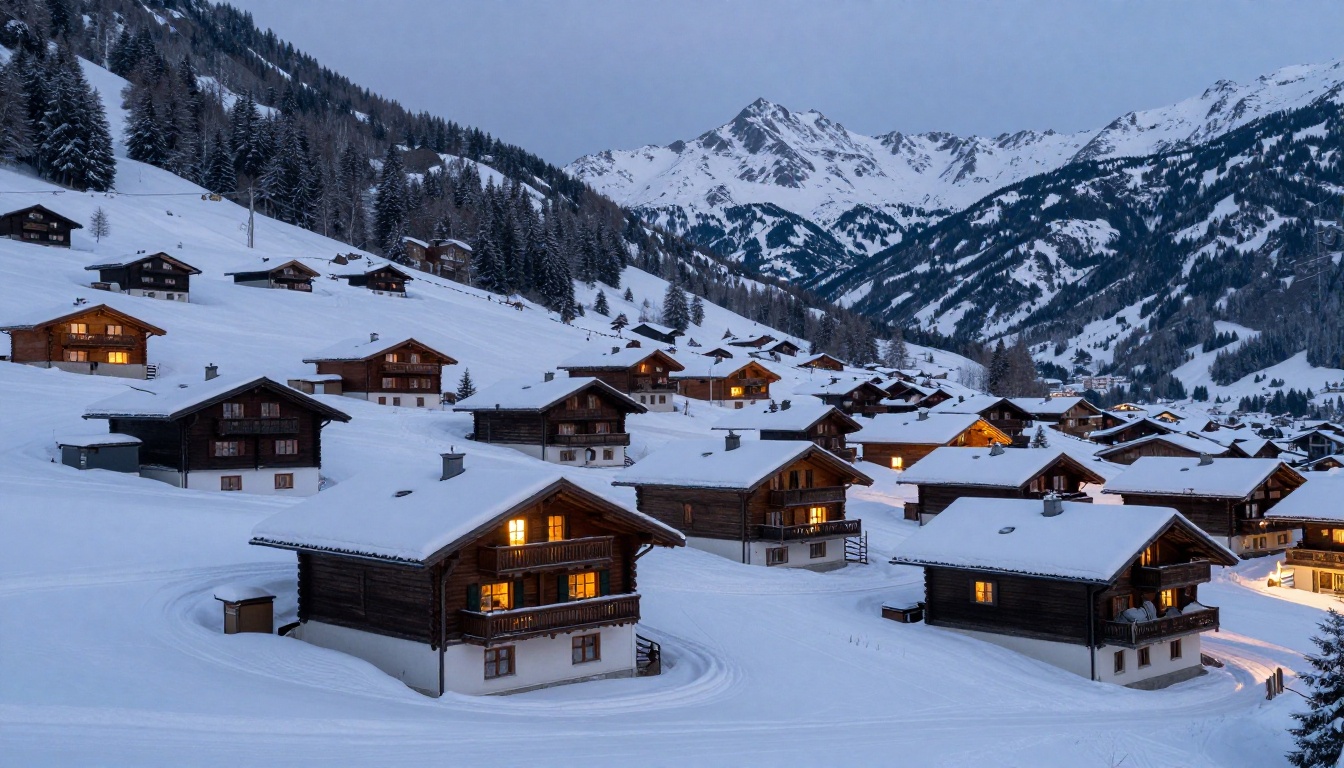
You've done Courchevel 1850. You've survived the Verbier après scene. You've paid $35 for a burger at the base of Aspen Mountain. And somewhere around your sixth trip, you started noticing that the skiing itself — the actual time spent on snow — was becoming the smallest part of the experience. The lift queues at peak season, the jostling for restaurant tables at noon, the sensation of being inside a very expensive theme park. There is another way to ski, and it doesn't require a helicopter.
What follows are seven resorts with genuine infrastructure — lifts, groomed runs, patrol, lodges — where the crowds never materialised or have been deliberately kept out. These are not backcountry operations or cat-skiing outfits. They are proper ski areas with serious terrain, serious snowfall, and a fraction of the traffic at the marquee names. The skiing is harder, the lodging is better, and the lift lines are measured in seconds, not minutes.
Lech-Zürs, Austria: The Quiet Side of the Arlberg
Lech has been on the radar of European aristocracy since the 1920s, and the town has spent the last century doing something remarkably difficult: growing its reputation while shrinking its capacity. Strict bed-cap limits — enforced by municipal law — mean the number of skiers on the mountain is physically capped. Compare this with neighbouring St. Anton, which has no such restrictions and feels it on every powder day.
The White Ring circuit is the draw for strong intermediates and above: a 22-kilometre loop connecting Lech, Zürs, Zug, and Oberlech that takes three to four hours at a comfortable pace. The terrain is varied and consistently steep enough to keep your attention. For experts, the off-piste between Zürs and Lech — particularly the Madloch run — is among the best lift-accessed freeride terrain in Austria.
Hotel Aurelio sits at the top of the village and starts around €1,500 per night for a junior suite. Twelve rooms. A Michelin-starred restaurant. A 1,500-square-metre spa that you will likely have to yourself. The après scene at Rüfana is warm wine and conversation at a reasonable volume — a deliberate counterpoint to the chaos of Mooserwirt in St. Anton. If you want to feel like you're in the Alps rather than at a party that happens to be in the Alps, Lech delivers that.
Saas-Fee, Switzerland and Alta, Utah: Purity by Design
Saas-Fee and Alta share almost nothing geographically but are built on the same principle: the resort exists to serve the mountain, not the other way around. Saas-Fee is car-free. You park in a garage at the village entrance and walk or take an electric taxi to your hotel. At 1,800 metres, the village sits in a bowl surrounded by thirteen 4,000-metre peaks, and the glacier skiing runs through summer. The Allalin revolving restaurant, perched at 3,500 metres, completes a full rotation every hour and serves surprisingly competent Swiss-Italian food while you watch the Mischabel range slide past the window.
Hotel Capra opened in 2017 and brought genuine contemporary luxury to a village that previously topped out at solid three-star. Rooms start around CHF 800 per night, and the design is warm alpine modernism — stone, timber, and wool in proportions that feel considered rather than decorated. The ratio of locals to visitors remains decisively in favour of the locals, which gives the village a texture that manufactured resort towns cannot replicate.
Alta, Utah operates on a different kind of purity: snowboarders are banned. This isn't a relic that the resort forgot to update — the policy is actively maintained and fiercely defended by the community. The result is a mountain that skis differently. No one is side-slipping down narrow traverses. The snow stays untracked longer. Alta averages over 500 inches of annual snowfall, and the powder here — the cold, dry, 'greatest snow on earth' that Utah puts on its licence plates — is not marketing. It is measurably lighter and drier than what falls in the Rockies or the Sierra.
Rustler Lodge starts around $600 per night and operates on a model that barely exists anymore: a ski-in, ski-out lodge with an outdoor heated pool, a dining room that serves a proper multi-course dinner, and absolutely no interest in becoming a lifestyle brand. The expert terrain — Baldy Chute, High Rustler, the Catherine's Area — rivals anything in the European Alps for steepness and consequence. The mountain closes at 4:30, the lodge serves dinner at 7, and the bar is quiet by 10. That's the deal, and it works.
The best ski resorts share one quality with the best restaurants: they decided what they are, and they stopped trying to be anything else.
Niseko and Courmayeur: East Meets Alps
Niseko Village on Hokkaido receives more than 15 metres of snowfall annually. That number is not a misprint. The snow falls from Siberian weather systems crossing the Sea of Japan, and it arrives with a moisture content so low that the Japanese call it 'aspirin powder' — it squeaks underfoot like polystyrene. The snow gives rather than resists, and you can ski steeper terrain with less risk because the landing is always soft.
The Higashiyama Niseko Village, a Ritz-Carlton Reserve, starts around $400 per night and gives you direct gondola access from the hotel lobby. But the real luxury in Niseko isn't the hotel — it's the onsen. After six hours in waist-deep powder, you strip down, wash at a low wooden stool, and lower yourself into naturally heated volcanic water while snow falls on your shoulders. This is not a spa treatment. It's a daily practice, and it changes the rhythm of a ski trip entirely. The food scene has grown to rival mid-tier Tokyo, with izakaya, ramen shops, and omakase counters that have no business being this good in a ski town. Best visited December through February. Avoid Chinese New Year week, when crowds spike and prices double.
Courmayeur sits on the Italian side of Mont Blanc and operates in permanent, comfortable shadow of Chamonix. The French side gets the mountaineering prestige, the steep couloirs, and the crowds. The Italian side gets better weather, better food, and a fraction of the traffic. The Skyway Monte Bianco cable car — a rotating glass cabin that ascends to 3,466 metres — is worth the trip alone for the panoramic views of the Western Alps.
Auberge de la Maison, starting around €350 per night, is a family-run hotel with the kind of wood-paneled dining room where they remember your wine preference from last year. This is the Aosta Valley, a bilingual Italian-French region with its own food traditions: fontina cheese, carbonada beef stew, lard d'Arnad. The mountain restaurants serve proper sit-down meals rather than the cafeteria-style refuelling you endure at most Alpine ski areas. Courmayeur has perhaps 40% of Chamonix's skiable terrain, but on any given Saturday in February, it has about 15% of the people.
Andermatt and Revelstoke: The New Guard
Andermatt was a sleepy Swiss garrison town until Egyptian billionaire Samih Sawiris arrived in 2005 with a CHF 1.8 billion development plan. The centrepiece is The Chedi Andermatt , designed by Jean-Michel Gathy, who also designed the Aman Tokyo and several One&Only properties. Rooms start around CHF 900 per night, and the interiors blend dark Alpine timber with Southeast Asian spatial principles — high ceilings, recessed lighting, a 2,400-square-metre spa with a 35-metre indoor pool. The SkiArena now connects Andermatt to Sedrun and Disentis, offering 120 kilometres of runs across three valleys, and the Gemsstock peak above town provides serious off-piste for advanced skiers.
What makes Andermatt remarkable is scale of ambition against scale of awareness. Sawiris rebuilt the village — apartments, hotels, a concert hall — but the international skiing public has been slow to notice. The train from Zürich takes two hours. The snow record is reliable. The village has year-round life. And yet on a Tuesday in January, you can ski the Gemsstock north face with perhaps a dozen other people on the entire mountain.
Revelstoke, British Columbia, is the final piece, and it makes a claim that is easily verified: North America's largest vertical drop at 1,713 metres. The resort opened its lift system only in 2007, which means the infrastructure is modern while the mountain itself — steep, gladed, and buried under 30-plus feet of annual snowfall — feels untamed. You can ski groomed cruisers in the morning, switch to cat skiing in the afternoon, and be back at the base lodge for dinner without leaving the resort's footprint.
The Regent Hotel starts around $350 per night and sits in the town of Revelstoke itself, which remains a working mountain community with hardware stores and diners alongside the newer coffee shops. This is not Whistler. There is no pedestrian village designed by a branding agency. The authenticity is structural, not performed, and for a certain kind of skier, that distinction matters enormously.
Revelstoke's 1,713-metre vertical drop is not just a statistic. It means your legs will tell you things about your fitness that a gym never will.
When to Book and What to Pack
Timing follows a reliable hierarchy. The best chalets at Lech, Andermatt, and Niseko book 12 months in advance — sometimes further out for peak weeks like Christmas and Presidents' Day. Hotel rooms at properties like Aurelio and The Chedi fill three to six months ahead for high season (late January through mid-March in Europe, December through February in Japan). Shoulder weeks — the first two weeks of January after New Year, and mid-March — offer the best combination of availability and snow conditions. Book shoulder if you can be flexible with dates.
Packing for serious mountain skiing is different from packing for a weekend at a manicured resort. A helmet is non-negotiable at any altitude above 2,500 metres, and honestly, it should be non-negotiable everywhere. A neck gaiter outperforms a cashmere scarf in every measurable way when you're skiing at speed in cold wind — it stays in place, wicks moisture, and doesn't fly off the chairlift. Base layers should be merino wool or synthetic, never cotton, which retains moisture and will leave you shivering on a long gondola ride. And pack goggles with interchangeable lenses — a dark lens for bluebird days and a yellow or rose lens for flat light, which you will encounter far more often than the brochure photos suggest.
The resorts on this list share a quality that is increasingly rare in the luxury travel landscape: restraint. They have chosen to remain small, or difficult to reach, or philosophically opposed to growth. That restraint is the product. The empty slopes, the quiet lodges, the mountains that feel like mountains rather than venues — these disappear first when a resort scales up. Seek them out while they still exist in this form.
Looking for luxury brands, stores, and services? Browse our curated directory: