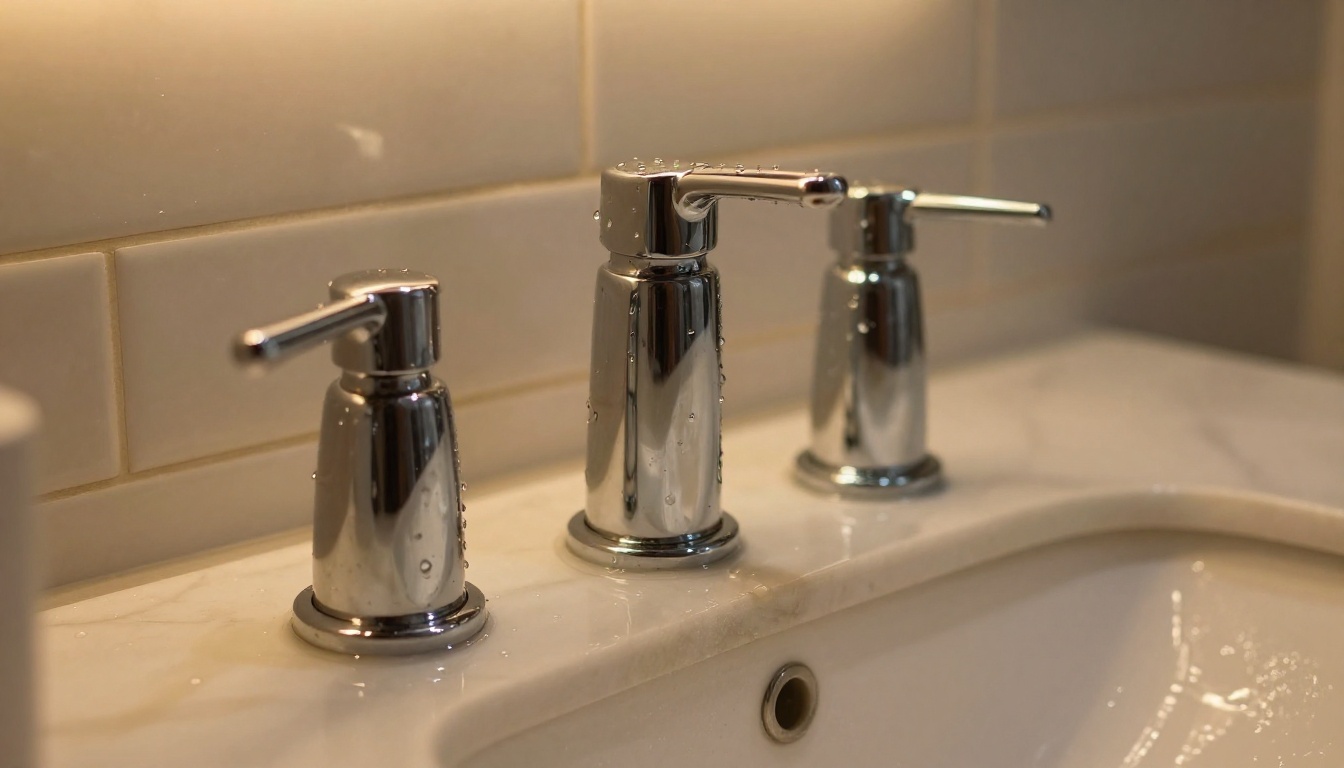
Strip the tiles off a $30,000 bathroom and a $5,000 one, and behind the walls is where the gap becomes obvious. The shower valve in the first is a Dornbracht thermostatic cartridge with a 0.5-degree temperature tolerance. The second uses a builder-grade pressure-balance valve that swings between scalding and cold every time someone flushes a toilet downstairs. Both bathrooms photograph the same. Only one of them works.
The plumbing specification is the single most consequential decision in a bathroom renovation, and it is the one most often handed to a contractor to figure out. That is a mistake. The difference between a considered spec and a default one determines how the room feels for the next twenty years, and most of that difference is invisible once the walls close up.
The Three Tiers of Bathroom Plumbing
Every bathroom plumbing spec falls into one of three tiers, and the gap between them is not incremental. Moving from builder-grade to mid-range adds comfort. Moving from mid-range to specification-grade adds precision, silence, and longevity that compounds over years of daily use.
Total Plumbing Spec Cost by Tier
At the builder-grade level ($4,000-$5,000 total), fixtures come from whatever the plumber stocks. Delta or Moen fittings, American Standard sanitaryware, a standard cistern. Everything works. Nothing distinguishes itself.
The mid-range tier ($12,000-$15,000) introduces brands like Hansgrohe, Kohler's upper lines, and Duravit sanitaryware. The thermostatic mixing is more precise, the ceramic quality improves, and the flush mechanisms get quieter. This is where most well-designed bathrooms land, and it is a defensible choice.
The specification-grade tier ($25,000-$30,000+) is where Dornbracht, Vola, and THG Paris fittings enter the picture. Sanitaryware comes from Toto's Neorest line, Laufen's Val collection, or Duravit's Starck collaborations. The concealed cistern is a Geberit Sigma or Omega. The underfloor heating is a Schluter Ditra-Heat or Warmup system with per-zone thermostatic control. This tier is what good architects specify, and the reasons are almost entirely about what happens behind the finished surfaces.
Fittings: Dornbracht vs. Vola vs. THG Paris
The three names that appear most often on high-end plumbing specifications are Dornbracht, Vola, and THG Paris. Each occupies a slightly different position, and the choice between them is as much about design philosophy as engineering.
builds its fittings in Iserlohn, Germany, and the engineering reflects it. Their thermostatic cartridges hold temperature to within half a degree Celsius. The valve bodies are solid brass, not zinc alloy with a brass finish. The internal flow paths are designed to minimize turbulence, which means less noise in the walls and more consistent pressure at the outlet. The Tara series remains their most specified line for residential projects, and the recent Tara Ultra has the same internals in a slimmer profile.
is the Danish alternative, and the design language is unmistakably Scandinavian. Arne Jacobsen designed the original fitting in 1968, and the line has barely changed since. The engineering is precise but less technically ambitious than Dornbracht's — Vola uses standard ceramic disc cartridges rather than proprietary thermostatic systems. The trade-off is simplicity: when a Vola cartridge fails in fifteen years, any competent plumber can source a replacement. Dornbracht cartridges require ordering directly from the manufacturer.
THG Paris occupies the opposite end of the spectrum. These are French-made fittings finished by hand, often in unlacquered brass or nickel that develops a patina. THG's internal engineering is comparable to Dornbracht's, but the finish work is where the premium goes. A THG lever handle has the weight and precision of a fine watch crown. The drawback is price: a THG shower set can run $4,000-$6,000 for fittings alone, nearly double Dornbracht and triple Vola.
High-End Fittings Compared
| Brand | Country | Shower Set Price | Cartridge Type | Finish Options | Warranty |
|---|---|---|---|---|---|
| Dornbracht | Germany | $2,200-$3,500 | Proprietary thermostatic | 30+ | 5 years |
| Vola | Denmark | $1,500-$2,800 | Standard ceramic disc | 15+ | 5 years |
| THG Paris | France | $4,000-$6,000 | Proprietary thermostatic | 50+ | 2 years |
| Hansgrohe Axor | Germany | $1,200-$2,200 | Standard ceramic disc | 20+ | Limited lifetime |
The honest answer: Dornbracht offers the best balance of engineering and cost for most projects. Vola wins on longevity of design and serviceability. THG is for projects where the fittings are visible design statements, not concealed behind walls. Hansgrohe's Axor line, while a tier below, offers surprisingly close performance at roughly half the cost and carries a more generous warranty — a detail worth noting.
Sanitaryware: What Separates a $500 Toilet from a $5,000 One
The toilet is the fixture most people underestimate. A builder-grade toilet costs $200-$400, flushes adequately, and looks like every other toilet. A Toto Neorest costs $5,000-$12,000, and the gap is not about aesthetics.
uses 's Tornado Flush system, which cleans the bowl with a cyclonic rinse using just one gallon of water per flush. The seat is heated with adjustable temperature zones. The lid opens and closes automatically via motion sensor. The integrated bidet uses electrolyzed water (eWater+) for self-cleaning. The CeFiONtect glaze on the bowl is a nanoscale ceramic coating that prevents waste adhesion at a molecular level. None of this is visible. All of it matters daily.
Duravit occupies the middle ground, particularly the SensoWash line and the ME by Starck series designed by Philippe Starck. The sanitaryware itself is well-made European ceramic, but the technology is less advanced than Toto's. Duravit's strength is in coordinating entire bathroom suites — basin, toilet, bathtub — with a unified design language, which simplifies specification for designers.
Laufen, the Swiss manufacturer, has earned a strong following among architects for the Val and Kartell collections designed by Konstantin Grcic and Ludovica+Roberto Palomba respectively. Laufen's proprietary SaphirKeramik material is thinner and stronger than traditional ceramic, allowing for sharper edges and slimmer profiles that would crack in standard porcelain. The engineering is genuine innovation, not marketing. The drawback: SaphirKeramik basins are more prone to visible mineral deposits in hard-water areas and require more attentive cleaning.
Behind the Walls: Concealed Cisterns and Carrier Systems
The Geberit concealed cistern is the single most specified plumbing component in high-end European bathrooms, and for good reason. The Sigma and Omega series mount inside the wall cavity, supporting wall-hung toilets that leave the floor completely clear — making the bathroom easier to clean, easier to tile, and visually lighter.
A Geberit Duofix frame costs $400-$800 depending on configuration. It supports up to 400 kilograms, uses a dual-flush mechanism rated for 300,000 cycles, and includes sound-dampening insulation that reduces flush noise to near silence. The flush plates (the visible button) range from $80 for basic plastic to $600 for brushed stainless steel or glass. Anyone who has lived with both a floor-mounted and wall-hung toilet in the same house understands the difference immediately.
The Geberit concealed cistern is the one component that every good architect specifies regardless of budget tier. It is also the one most often value-engineered out by contractors trying to save $300.
The alternative is Grohe's Rapid SL frame system, which performs comparably but has a slightly smaller service opening — a detail that matters only when a plumber needs access in fifteen years. TECE, the German manufacturer, makes a third option with a wider service panel and easier valve access, favored by plumbers who have dealt with enough callbacks. For new construction or gut renovations, any of the three work well. For retrofit projects where wall depth is constrained, Geberit's slimmer profile (8cm for the Kombifix frame) gives more flexibility.
Underfloor Heating: The Invisible Difference
Electric underfloor heating in a bathroom costs $800-$2,000 installed, depending on floor area and system. It is also the single highest-impact upgrade per dollar in any bathroom renovation. Stepping onto a heated stone floor at 6 AM in January is the kind of daily comfort that no amount of tile selection or vanity styling can replicate.
Two systems dominate the specification-grade market. Schluter Ditra-Heat combines an uncoupling membrane (which prevents tile cracking from substrate movement) with integrated heating cables. It solves two problems with one product, which reduces total floor buildup — critical in renovations where every millimeter of floor height matters for door clearances and transitions. Warmup uses a thinner cable mat that can go directly under tile, but lacks the uncoupling function and requires a separate membrane on problematic substrates.
Underfloor Heating Systems
| System | Installed Cost (50 sq ft) | Floor Buildup | Thermostat | Warranty |
|---|---|---|---|---|
| Schluter Ditra-Heat | $1,200-$1,800 | 5.5mm | WiFi optional | Limited lifetime |
| Warmup DCM-PRO | $800-$1,200 | 3.5mm | WiFi standard | 25 years |
| Nuheat Mat | $600-$900 | 3mm | WiFi optional | 25 years |
| HeatTech (builder grade) | $300-$500 | 3mm | Basic dial | 10 years |
The thermostat matters more than most specifications suggest. A programmable WiFi thermostat allows scheduling the floor to warm before wake-up and cool during vacant hours. The running cost for a typical bathroom — around 50 square feet of heated area — is roughly $0.15-$0.25 per day. Over a year, that is under $90. The comfort-to-cost ratio is difficult to beat anywhere in a home renovation. For those already considering smart home integration, most WiFi thermostats connect to existing systems without additional wiring.
The Spec Nobody Reads: Water Pressure and Pipe Sizing
A $3,000 Dornbracht rain shower head delivering water through undersized 1/2-inch supply lines will feel worse than a $200 shower head on properly sized 3/4-inch lines. Pipe sizing is the least discussed and most consequential element of a plumbing specification.
Specification-grade bathrooms typically run 3/4-inch trunk lines from the water heater, stepping down to 1/2-inch only at the final connection to each fixture. This ensures that simultaneous use — shower running while someone fills a bathtub — does not cause pressure drops. Builder-grade plumbing often runs 1/2-inch from the manifold to every fixture, which is code-compliant and immediately noticeable when two fixtures operate at once.
For homes with inconsistent municipal water pressure, a constant-pressure pump system (Grundfos SCALA2 or the DAB E.sybox) maintains steady pressure regardless of demand. These cost $1,500-$3,000 installed and solve a problem that no amount of expensive fittings can address on their own. A good plumber will recommend a pressure test before finalizing any fixture specification — if incoming pressure is below 40 PSI, the best fixtures in the world will underperform.
What a $30,000 Plumbing Spec Actually Looks Like
Here is where the money goes in a specification-grade bathroom plumbing package, broken down by component. This assumes a primary bathroom with a walk-in shower, freestanding tub, wall-hung toilet, and double vanity.
$30K Plumbing Spec: Line-Item Breakdown
| Component | Specification | Cost |
|---|---|---|
| Shower valve and trim | Dornbracht Tara thermostatic | $2,800 |
| Rain shower head (ceiling) | Dornbracht 300mm round | $1,200 |
| Hand shower and bar | Dornbracht Tara | $900 |
| Tub filler (freestanding) | Dornbracht Tara floor-mount | $3,200 |
| Basin faucets (x2) | Vola HV1 single-lever | $1,800 |
| Toilet | Toto Neorest RH | $5,500 |
| Concealed cistern | Geberit Sigma Duofix frame | $650 |
| Flush plate | Geberit Sigma70 brushed steel | $450 |
| Basins (x2) | Laufen Val 600mm undermount | $1,600 |
| Bathtub | Bette LUX Oval silhouette | $3,800 |
| Underfloor heating | Schluter Ditra-Heat (55 sq ft) | $1,500 |
| Thermostat | Schluter DITRA-E-WiFi | $250 |
| Constant-pressure pump | Grundfos SCALA2 | $2,200 |
| Pipe work (3/4" trunk) | PEX-A manifold system | $2,500 |
| Waste and drainage | McAlpine concealed traps | $400 |
| Total | $28,750 |
That total does not include installation labor ($3,000-$6,000 depending on market and complexity), tiles, vanity cabinetry, mirrors, or lighting. It is pure plumbing infrastructure and fixtures. The same bathroom with builder-grade specifications — Delta fittings, American Standard toilet, standard cistern, no underfloor heating — comes in around $4,000-$5,000 for materials. The gap is roughly $25,000, and none of it is visible in a photograph.
Where to Spend and Where to Hold Back
Not every component in a specification-grade bathroom justifies its premium equally. Some upgrades deliver daily returns. Others are engineering vanity.
- Always spend on the shower valve. A thermostatic valve with anti-scald protection and precise temperature control is the single most-used component in the room. Dornbracht or Hansgrohe Axor. Non-negotiable.
- Always spend on the concealed cistern. A Geberit frame costs $300 more than a builder-grade cistern and transforms the room. Wall-hung toilets are easier to clean, quieter, and free up floor space.
- Always spend on underfloor heating. Under $2,000 installed for a complete system. The daily impact is disproportionate to the cost.
- Consider carefully before spending on the toilet. A Toto Neorest is remarkable engineering, but a Toto Drake II at $400 with a separate Toto Washlet bidet seat at $800 delivers 80% of the functionality at 20% of the cost. The integrated unit is sleeker but the modular approach is more practical for most homes.
- Hold back on decorative trim finishes. Brushed nickel and matte black finishes from Dornbracht cost 30-50% more than chrome. The chrome finish is actually more durable and easier to maintain. Unless the design concept demands a specific finish, chrome is the technically superior choice.
The same logic applies to bathroom renovations as it does to working with a designer on any interior project: the money that goes into invisible infrastructure yields more satisfaction than the money spent on visible surfaces. A perfectly tiled bathroom with inconsistent water pressure and a cold floor is a disappointment. A simply tiled bathroom with precise thermostatic control, heated floors, and a silent flush is a room that works exactly as intended, every single morning, for decades.
Warranty Length by Brand
One final note on warranties: the chart above reveals a counterintuitive pattern. The most expensive fittings — Dornbracht, Vola, THG — carry the shortest warranties. This is not because they fail sooner. It reflects a European manufacturing tradition where warranty is considered a legal obligation rather than a marketing tool. Geberit and Hansgrohe offer longer warranties partly because their products are more commoditized and warranty claims are rarer on concealed components. The real measure of durability is whether replacement parts will still be available in twenty years. On that metric, Dornbracht and Vola both maintain parts inventories for discontinued lines going back decades — a commitment that no warranty document captures.