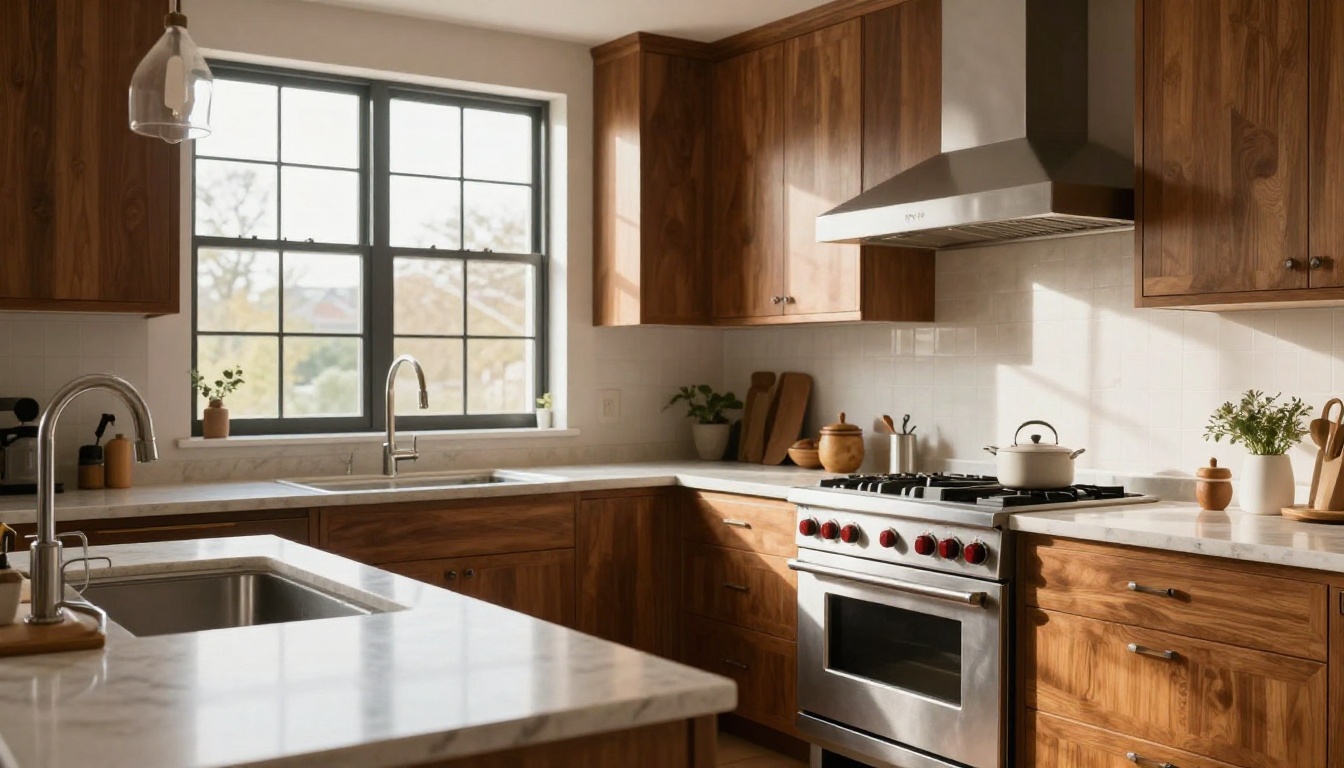
Three Kitchens, Three Price Tags, Very Different Returns
A kitchen renovation at $75,000 and one at $300,000 can look almost identical in photographs. The difference shows up in how the drawers close, how the countertop ages after five years of actual cooking, and whether a buyer's appraiser adds value to your home or shrugs.
The residential kitchen market has split into three distinct tiers, each with its own logic. The $75K build is a strategic renovation — targeted upgrades that recover 60-80% at resale. The $150K build is where most serious home cooks land, balancing performance with long-term value. The $300K build is a lifestyle statement, and anyone doing it should understand that roughly half the spend is pure personal preference with minimal resale return.
Here is what actually matters at each level — and what is just expensive wallpaper.
The $75K Kitchen: Strategic and Sufficient
At this budget, the goal is clear: replace what is worn, upgrade what affects daily use, and do not overcapitalize for the neighborhood. This typically means stock or semi-custom cabinetry from a reputable manufacturer, a solid surface countertop, and appliances in the $8,000-$15,000 range total.
The smartest move at $75K is spending disproportionately on the range and the countertop, and being disciplined everywhere else. A at around $7,000-$9,000 is the single biggest quality-of-life upgrade you can make. Pair it with quartz countertops — Caesarstone or Cambria — and you have a kitchen that performs well and photographs well enough to impress buyers.
What to skip at this level: under-cabinet lighting systems that cost more than $2,000, pot fillers (a plumber's future service call), and any backsplash tile that costs more than $25 per square foot. The ROI math is straightforward. The National Association of Realtors consistently puts major kitchen remodel recovery at 75% for midrange projects. At $75K in a home valued at $500K-$800K, that math works.
The $150K Kitchen: Where Performance Lives
This is the inflection point where you stop making compromises. Semi-custom or full custom cabinetry with dovetail joints and soft-close everything. A professional-grade appliance suite. Natural stone countertops that can handle heat and abuse. If you cook seriously and entertain at home regularly, this is the tier that makes functional sense.
The appliance conversation gets interesting here, because the $150K budget is where you choose a philosophy, not just a brand.
The Appliance Hierarchy
Three brands dominate the high end, and each serves a different cook. The — typically a 48-inch or 60-inch model in this tier — is the workhorse choice. Wolf's dual-stacked burners deliver precise simmer control alongside 20,000 BTU output. It is the choice of people who actually cook every day and want reliability backed by a strong service network. Expect $12,000-$22,000 depending on configuration.
The takes a different approach: modular cooktops, separate wall ovens, and steam combination units. Gaggenau's engineering is German-precise, and their ventilation systems are the quietest at full extraction. The modular approach costs more — a full Gaggenau suite runs $25,000-$45,000 — but it lets you configure a kitchen around how you actually work, rather than building around a single range. The trade-off is a thinner service network in some U.S. markets and parts availability that can test your patience.
Then there is , which starts around $50,000 for a 75cm model and climbs past $150,000 for the Grand Palais. La Cornue is a remarkable piece of engineering — vaulted oven chambers that produce exceptional heat circulation, hand-assembled in a single French workshop. But it is not the best tool for every cook. The burners are gas-only with no dual-fuel option, the oven calibration takes time to learn, and servicing outside of major metros requires flying in a specialist. La Cornue is for the cook who also considers the range a piece of furniture. If that is you, it delivers. If you want to sear, roast, and braise with minimal fuss, Wolf or Gaggenau will outperform it for less money.
High-End Kitchen Appliance Brands Compared
| Brand | Typical Suite Cost | Best For | Burner Output | Oven Type | Service Network |
|---|---|---|---|---|---|
| Wolf | $15,000-$30,000 | Daily serious cooks | Dual-stacked, 20K BTU | Convection + Broil | Excellent (US) |
| Gaggenau | $25,000-$45,000 | Modular configurators | Varies by module | Steam + Convection | Good (limited rural) |
| La Cornue | $50,000-$200,000+ | Design-first cooks | Gas only, 15K BTU | Vaulted chamber | Limited |
| Miele | $12,000-$25,000 | Reliability seekers | Standard, 19K BTU | Moisture Plus | Very good |
| Thermador | $10,000-$22,000 | Value at high end | Star burners, 22K BTU | Convection | Good |
Refrigeration matters more than most people realize. A Sub-Zero 48-inch built-in at $15,000-$20,000 preserves food measurably better than a $3,000 unit — dual compressors, NASA-derived air purification, and temperature stability within one degree. For someone who shops at farmers' markets and keeps a serious pantry, this is not vanity spending. For someone who mostly stores takeout and sparkling water, it is.
Countertops: Performance vs. Photography
This is where the gap between what looks good on Instagram and what works in a real kitchen is widest.
Marble — specifically Calacatta and Statuario — remains the most photographed countertop material and the worst performer for actual cooking. It etches from lemon juice, stains from red wine, and develops a patina that marble enthusiasts call "character" and everyone else calls "damage." A full Calacatta slab kitchen runs $15,000-$30,000 installed, and it will look different in eighteen months no matter how diligently you seal it.
Quartzite — not quartz, but natural quartzite like Taj Mahal or Sea Pearl — offers the veined aesthetic of marble with dramatically better durability. Harder than granite, resistant to etching, and heat-tolerant enough for a hot pan (though trivets are still wise). Quartzite slabs run $80-$150 per square foot installed, making a full kitchen $10,000-$20,000. This is the material that designers who actually cook tend to put in their own homes.
Engineered quartz from brands like Caesarstone and Silestone occupies the $50-$100 per square foot range and remains the most practical choice for most kitchens. Zero porosity means no sealing, no staining, and consistent appearance for decades. The drawback: it cannot handle direct heat from pans, and the patterning, while improved, still reads as manufactured in person.
Kitchen Countertop Materials: Performance vs. Aesthetics
| Material | Cost/sq ft (installed) | Heat Resistance | Stain Resistance | Maintenance | Best For |
|---|---|---|---|---|---|
| Calacatta Marble | $100-$250 | Poor | Poor | High (regular sealing) | Light-use show kitchens |
| Natural Quartzite | $80-$150 | Very Good | Good | Low-Medium | Serious cooks who want beauty |
| Engineered Quartz | $50-$100 | Poor (no hot pans) | Excellent | Very Low | Practical daily kitchens |
| Granite | $40-$80 | Excellent | Good | Low (annual seal) | Budget performance |
| Porcelain Slab | $60-$120 | Excellent | Excellent | Very Low | Modern aesthetic |
| Dekton | $70-$130 | Excellent | Excellent | Very Low | Outdoor/indoor versatility |
The $300K Kitchen: Lifestyle Spending with Eyes Open
At $300,000, you are no longer renovating — you are building a room from scratch. Fully custom cabinetry from a workshop (not a factory), likely with features like integrated LED channel lighting, motorized shelving, and panels designed to conceal every appliance behind a seamless millwork facade. A strong interior designer is non-negotiable at this level — not for taste, but for managing the dozen specialist trades that need to coordinate.
The money at this tier goes to three places: the cabinetry (often 40-50% of budget), the appliances (20-30%), and the surfaces and fixtures (the remainder). A fully paneled Sub-Zero and Wolf suite behind custom oak or walnut panels, a La Cornue in a custom colorway, integrated Gaggenau coffee and steam systems, under-counter wine conditioning — it adds up fast and it adds up quietly.
Cabinet Construction: What Separates $500 per Linear Foot from $2,000
Cabinetry is where most of the money hides in a high-end kitchen, and it is also where the quality differences are most tangible. Open a drawer in a stock kitchen and one in a fully custom build, and the difference is immediately apparent — the weight, the travel, the silence of the close.
Stock cabinets ($150-$300 per linear foot) use stapled face-frame construction with particleboard boxes and laminate interiors. They work. They last 15-20 years before looking tired. Semi-custom ($300-$700 per linear foot) upgrades to plywood boxes, dovetailed drawers, and better hardware — Blum Tandembox or equivalent. Full custom ($800-$2,000+ per linear foot) means solid hardwood face frames, hand-fitted inset doors, and interior finishes that match the exterior. The hardware at this level — Blum Legrabox or Hettich with integrated damping — is a small expense relative to the total but one of the first things a buyer's hand will test.
The tells of quality cabinetry are not hard to spot once you know them. Look at the interior corners: mitered and glued, or butted and stapled? Pull a drawer fully out: does it extend on full-extension slides, or does it stop short? Close a door: does it catch magnetically, or does it soft-close with hydraulic precision? These details separate a kitchen that feels considered from one that merely looks it.
What Resale Actually Values
Real estate appraisers and buyers' agents are consistent about what moves the needle and what does not. Layout matters more than finish level — an open kitchen that connects to living space recovers better than a closed galley, regardless of materials. Appliance brand recognition matters, and Wolf, Sub-Zero, and Miele are the names that register with appraisers. La Cornue, despite costing three to five times more, gets the same appraised value as Wolf because the comparables do not exist in the local market.
The features that consistently add appraisal value: large center island with seating, professional-grade range with hood, stone countertops (any type), soft-close full-overlay or inset cabinetry, and under-cabinet task lighting. The features that do not: pot fillers, custom range hoods over $5,000, imported tile backsplashes, and warming drawers. Buyers see them but do not pay extra for them.
The same pattern holds for bathroom renovations — certain upgrades recover reliably while others are pure personal enjoyment. There is nothing wrong with that, as long as you are honest about which column your spending falls into.
Kitchen Renovation ROI by Budget Tier
| Budget Tier | Typical Spend | Est. Resale Recovery | Recovery Rate | Where Value Is Lost |
|---|---|---|---|---|
| Strategic ($75K) | $60,000-$90,000 | $45,000-$70,000 | 70-80% | Rarely — well-matched to market |
| Performance ($150K) | $120,000-$180,000 | $75,000-$110,000 | 55-65% | Appliance premiums over Wolf/Miele |
| Statement ($300K) | $250,000-$350,000 | $100,000-$150,000 | 35-45% | Custom cabinetry, La Cornue, rare stone |
The Decisions That Actually Matter
After watching dozens of kitchen renovations — some brilliant, some expensive mistakes — a few patterns emerge about where money has the highest return on daily satisfaction, not just resale.
- Ventilation is the most underinvested category. A range hood should move 600-1,200 CFM with makeup air, and it should be quiet enough to leave running. Budget $2,000-$5,000 for a hood that works properly. Recirculating hoods are decorative objects pretending to be appliances.
- Drawer storage beats door storage. Deep drawers for pots, shallow drawers for utensils, and wide drawers for sheet pans. Converting even half the lower cabinets to drawers changes how a kitchen functions. Hettich and Blum systems cost $150-$400 per drawer — meaningful money that disappears into daily convenience.
- Lighting has three layers. Task (under-cabinet), ambient (recessed or pendant), and accent (in-cabinet or toe-kick). Most renovations nail one and forget the others. A kitchen with good lighting at all three levels feels like a different room after dark.
- The sink and faucet get more daily use than the range. A Rohl or Waterstone faucet at $800-$1,500 and a deep single-basin sink are small upgrades with outsized daily impact. Do not default to the cheapest option here.
- Integrate technology deliberately. A well-chosen smart home system can handle lighting scenes and ventilation. A poorly chosen one means fighting with an app every time you want to turn on the lights. Wired solutions (Lutron, Crestron) outperform wireless for reliability.
A Practical Sequence
For anyone planning a kitchen renovation above $100K, the sequence matters as much as the selections. Start with layout — and if the current layout does not work, accept the plumbing and electrical costs to fix it now, because you will never go back to move an island. Lock appliances next, because their dimensions dictate cabinetry. Then select countertop material, because edge profiles and sink cutouts need to be templated after cabinets are set. Backsplash and lighting come last.
Hire the designer before the contractor, not the other way around. A designer who specifies well reduces change orders, which are where renovation budgets actually die. Every change order on a $150K kitchen averages $2,000-$5,000 by the time materials and labor recalculate. Three change orders and you have bought a very nice vacation instead.
The kitchen that pays for itself is not the most expensive one. It is the one where every dollar went somewhere deliberate — where the cabinetry was built to last, the appliances match how you actually cook, and the surfaces were chosen for how they perform, not just how they look in the listing photos. Everything else is lifestyle spending. Enjoy it, but call it what it is.
Looking for luxury brands, stores, and services? Browse our curated directory: