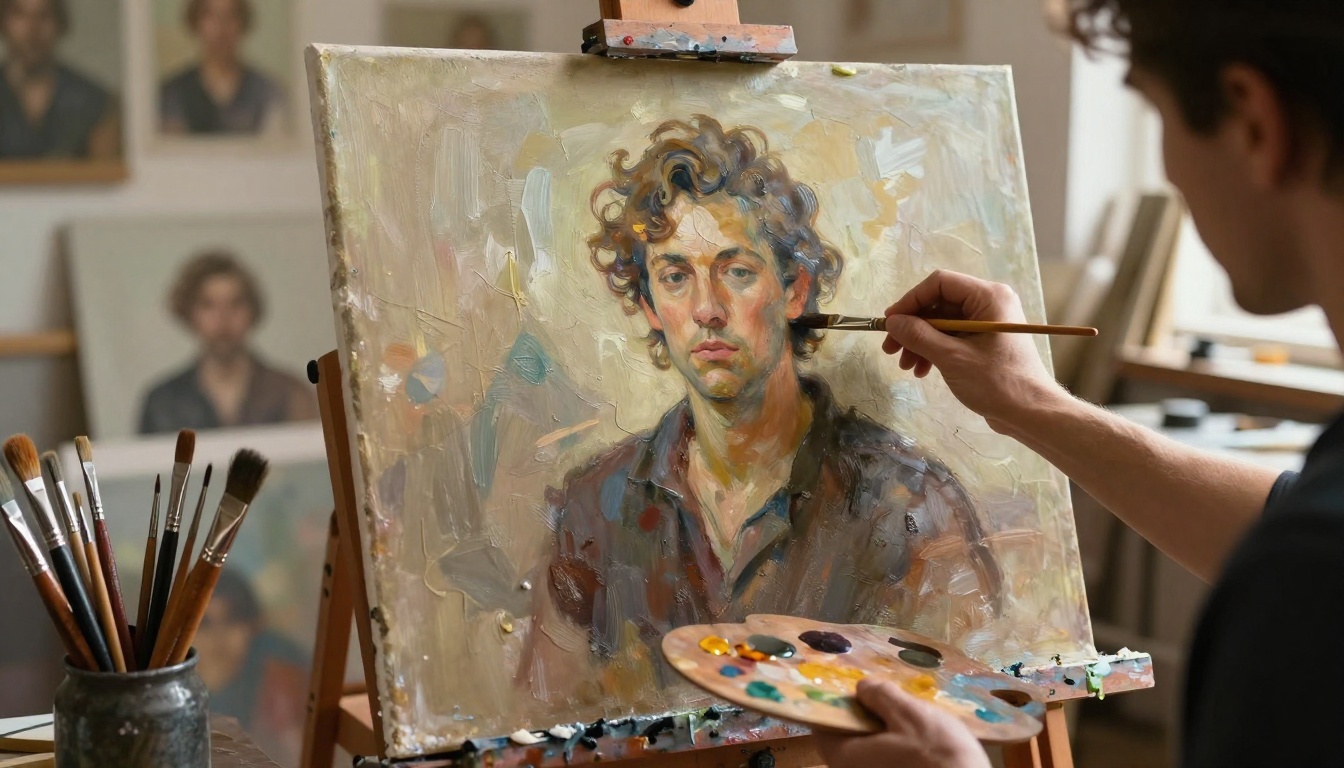
A Painting Made for You Is Not a Vanity Project
There is a portrait of my grandmother in her hallway. It was painted in 1974 by an artist whose name nobody outside of Edinburgh would recognize. The brushwork is confident but not flashy. The colors are muted — moss greens, warm grays, a single pop of coral at the collar. It cost, adjusted for inflation, roughly the same as a midrange sofa. Fifty years later, the sofa is long gone. The painting stops every visitor in their tracks.
Commissioned portraits carry a weight that gallery purchases rarely match. Not because they are technically superior — many are not — but because they encode a relationship between artist, sitter, and moment that no resale market can replicate. If you have spent time buying contemporary art or bidding at auction, a commission is the logical next step: art made with intention, for a specific wall, in a specific life.
The process is more straightforward than most people assume. It is also more nuanced than simply sitting in a chair while someone draws you. Here is what the $5,000 to $50,000 range actually gets, and how to navigate the process without wasting money or ending up with something you quietly move to the attic.
Finding the Right Artist
This is where most commissions succeed or fail, and it happens before a single brushstroke. The wrong artist is not just a bad investment — it is months of your time and an awkward conversation about a painting you will never hang.
Where to Look
Start with institutions, not Instagram. The Royal Society of Portrait Painters in London and the Portrait Society of America both maintain searchable member directories with portfolios. These are not vanity organizations — membership requires juried admission, which filters out hobbyists. The Royal Society's annual exhibition at the Mall Galleries is worth a trip if you are serious; you can see finished commissions in person and speak directly with artists.
Art schools are another underrated source. The Florence Academy of Art, the Repin Academy in St. Petersburg (now with satellite programs in Europe), and Charles H. Cecil Studios produce painters with rigorous classical training. Recent graduates often charge $3,000 to $8,000 for a head-and-shoulders portrait — a fraction of what they will charge in ten years, with technique that already rivals established names.
Galleries that specialize in figurative and representational art can also broker introductions. In London, look at the Fine Art Society and Messums. In New York, Adelson Galleries and Hirschl & Adler handle contemporary realists alongside their historical inventory. Expect the gallery to take a commission — typically 20 to 40 percent on top of the artist's fee — but the vetting and project management they provide can be worth it for a first-time buyer.
Social media works, but with caveats. An artist's Instagram feed shows their best angles, best lighting, and most flattering portraits. Ask to see work in person, or at minimum request high-resolution, unedited images of six to ten completed commissions. Pay attention to how they handle skin tones, fabric, and backgrounds — these are where shortcuts show up.
How to Evaluate Quality
Three things separate a competent portrait from a remarkable one:
- Likeness beyond accuracy — A photograph captures features. A good portrait captures expression, posture, the way someone holds their shoulders when they are thinking. Look at the artist's previous subjects and ask: do these people look alive, or do they look like photographs translated into paint?
- Hands — If the portfolio includes half-length or full-length portraits, study the hands. Hands are the hardest thing to paint convincingly. An artist who avoids showing them, or who consistently poses subjects with hands hidden, is telling you something.
- Backgrounds and composition — The least interesting portraits are head-and-shoulders against a neutral backdrop. The best ones place the subject in context — a study, a garden, a specific chair. This requires compositional skill beyond just rendering a face.
Choosing Your Medium
The medium affects price, timeline, visual impact, and where you can hang the finished piece. Each has trade-offs worth understanding before you commit.
Portrait Mediums Compared
| Medium | Typical Price Range | Timeline | Best For |
|---|---|---|---|
| Oil on Canvas | $5,000 - $50,000+ | 3-12 months | Formal portraits, large scale, longevity |
| Charcoal/Graphite | $2,000 - $10,000 | 2-6 weeks | Intimate studies, children, series |
| Watercolor | $3,000 - $12,000 | 4-8 weeks | Light-filled spaces, less formal settings |
| Pastel | $3,000 - $15,000 | 4-10 weeks | Soft tones, skin warmth, mid-size works |
| Photography | $2,000 - $20,000 | 1-4 weeks | Contemporary interiors, precise control |
Oil on canvas remains the default for a reason. It is the most archival medium — properly cared for, an oil painting lasts centuries. It handles scale well, from a 16x20-inch head study to a life-size full-length. The depth of color is unmatched; oils allow layering and glazing that builds luminosity no other medium can replicate. The downside is time. A serious oil portrait requires three to eight sittings over weeks or months, plus drying time between sessions and after completion. Budget at least six months from first sitting to delivery, and twelve months is not unusual for complex compositions.
Charcoal and graphite are not lesser mediums — they are different ones. A charcoal portrait by a skilled hand has an immediacy and directness that oil can never achieve. They work beautifully for children (who do not sit still for eight sessions), for studies that capture a specific age or moment, and for collectors who want a series over time. They are also significantly less expensive, making them an intelligent entry point. A well-framed charcoal portrait in a hallway or study holds its own against anything in oil.
Commissioned portrait photography is the option most people overlook. Not a headshot session — a proper portrait sitting with a photographer who works in large-format or medium-format, controls every element of lighting and composition, and delivers archival prints. Annie Leibovitz charges six figures, but photographers like Platon, Nadav Kander, or emerging artists working in a similar tradition charge $5,000 to $20,000 for a sitting with a set of finished prints. The results can be extraordinary, particularly in contemporary or minimal interiors where a painted portrait might feel out of place.
What the Process Actually Looks Like
Once you have chosen an artist, the commission follows a fairly standard sequence. Knowing what to expect makes the experience better for both sides.
The Initial Conversation
This is not a sales meeting — it is a creative brief. The artist will want to know: who is being painted, why, where it will hang, what size you are considering, and whether you have preferences on formality, clothing, background, and pose. Bring reference images of portraits you admire (from any era) and be honest about what you do and do not want. If you hate dark, Old Master-style backgrounds, say so now rather than discovering it on canvas.
The artist should also discuss pricing in this conversation. Expect a detailed quote that breaks down the cost by size and complexity. A head-and-shoulders oil portrait from an established artist typically runs $5,000 to $15,000. A half-length (including hands) is $10,000 to $25,000. A full-length, life-size oil portrait — the kind that hangs in boardrooms and country houses — starts around $20,000 and can exceed $50,000 for the most sought-after painters.
Sittings
For oil portraits, expect three to eight sittings of two to four hours each. The first sitting is the most important — this is when the artist establishes the composition, captures the pose, and begins blocking in the essential features. Some artists photograph the first sitting extensively and complete much of the work from photographs, using subsequent sittings for refinement. Others insist on painting entirely from life. Neither approach is inherently better, but you should know which one your artist uses before committing to the schedule.
Children under eight rarely sit for more than 30 to 45 minutes. Most portraitists who specialize in children work primarily from photographs and short observation sessions, with perhaps one or two formal sittings. This is normal and produces excellent results — the technique is well-established.
What to wear: bring two or three options and let the artist advise. Solid colors in muted tones photograph and paint better than patterns. Avoid logos, trendy cuts, or anything you would not wear five years from now. Jewelry should be minimal and meaningful. The most common regret in portrait commissions is choosing clothing that dates the painting unnecessarily.
Revisions
A professional portraitist will show you the work at an agreed midpoint — typically after the underpainting or first full pass is complete. This is when to raise concerns about likeness, expression, or color. Reputable artists expect and welcome feedback at this stage; the paint is still workable and changes are relatively straightforward.
After the final sitting, most artists allow one round of minor adjustments. Wholesale changes to pose, expression, or composition at this stage are a different matter — they may require additional sittings and will almost certainly increase the cost. This is another reason the initial conversation and reference images matter so much.
The Money — What Drives Cost Up and Down
Portrait pricing follows predictable logic once you understand the variables.
- Size — This is the single largest factor. A 16x20-inch head study requires a fraction of the canvas, paint, and time of a 48x60-inch half-length. Doubling the dimensions roughly triples the price.
- Number of subjects — A couple or family group portrait is not simply two or three individual prices added together, but it is significantly more than a single subject. Each additional person adds complexity to composition and sitting logistics. Budget an additional 40 to 60 percent per subject.
- Artist reputation — A recent graduate from a top atelier might charge $5,000 for a head-and-shoulders piece that an RP (Royal Society member with a 20-year track record) would price at $15,000. The quality gap is smaller than you might expect. The prestige gap is real but only matters if it matters to you.
- Complexity of setting — A plain background costs nothing extra. A detailed interior, landscape, or specific location (the artist's travel, reference photography, additional painting time) can add $3,000 to $10,000.
- Travel — If the artist must travel to you for sittings, expect to cover transport, accommodation, and a per diem. For international commissions, this can add $2,000 to $5,000.
Payment terms vary but typically follow a structure: 25 to 50 percent deposit on agreement, a second payment at the midpoint, and the balance on delivery. Get this in writing. A simple letter of agreement covering price, timeline, number of sittings, revision policy, and copyright (you own the physical painting; the artist typically retains reproduction rights) protects both sides. The process has parallels with commissioning work on Savile Row — a deposit, multiple fittings, and clear communication about expectations prevent most problems.
Framing and Hanging
A portrait's frame is not decorative trim — it is part of the presentation. The wrong frame diminishes even exceptional work. The right one completes it.
For oil portraits, work with a specialist framer, not a high-street chain. A good framer will advise on period-appropriate molding profiles, gilding options (water gilt versus oil gilt, hand-finished versus machine-applied), and whether the portrait needs glass (oils typically do not; works on paper always do). Budget $500 to $3,000 for framing, with hand-gilded frames at the upper end. Some portraitists have preferred framers and can coordinate this for you.
Hanging height matters more than most people realize. The center of the painting should sit at roughly 57 to 60 inches from the floor — average eye level. Portraits hung too high lose their connection with the viewer. In rooms with particularly high ceilings, you can go slightly higher, but the face should never be above comfortable eye contact range.
Lighting transforms a portrait. A properly lit painting has three to four times the visual impact of one relying on ambient room light. Picture lights — the brass or bronze fixtures mounted to the top of the frame — are the classic solution. LED picture lights from Hogarth or Tru-Slim run $200 to $600 and produce warm, even illumination without the heat that halogen bulbs generate. For a more architectural approach, consider recessed ceiling spots with adjustable heads aimed at the painting from a 30-degree angle. Your interior designer can integrate portrait lighting into a broader lighting plan.
Why a Commission Outlasts Everything Else on Your Wall
Gallery art and auction purchases have their place — they connect you to art history, to movements, to the broader conversation. But a commission creates something that does not exist anywhere else. It is a collaboration between your story and an artist's skill, fixed in a specific moment.
The paintings that families keep for generations are almost never the most expensive things in the house. They are the ones that capture a person, an expression, a particular afternoon. The chair someone sat in, the light through a specific window, the way a child held a book. These are details that no gallery purchase can provide, because they were never intended for anyone else.
A commissioned portrait at $10,000 to $20,000 sits comfortably in the range of enduring furniture or a significant piece of jewelry — and unlike either, it is genuinely irreplaceable. It does not follow trends, it does not depreciate with fashion, and fifty years from now, someone will stop in a hallway and ask about the person in the painting.
The best portrait commissions are not about ego. They are about attention — an artist spending forty hours looking at someone you love, and translating what they see into something permanent.
Start with a single portrait. A charcoal study of a child, a small oil of a parent or partner. Live with it for a year. If it changes the way you think about the art on your walls — and it almost certainly will — you will know whether to commission another.