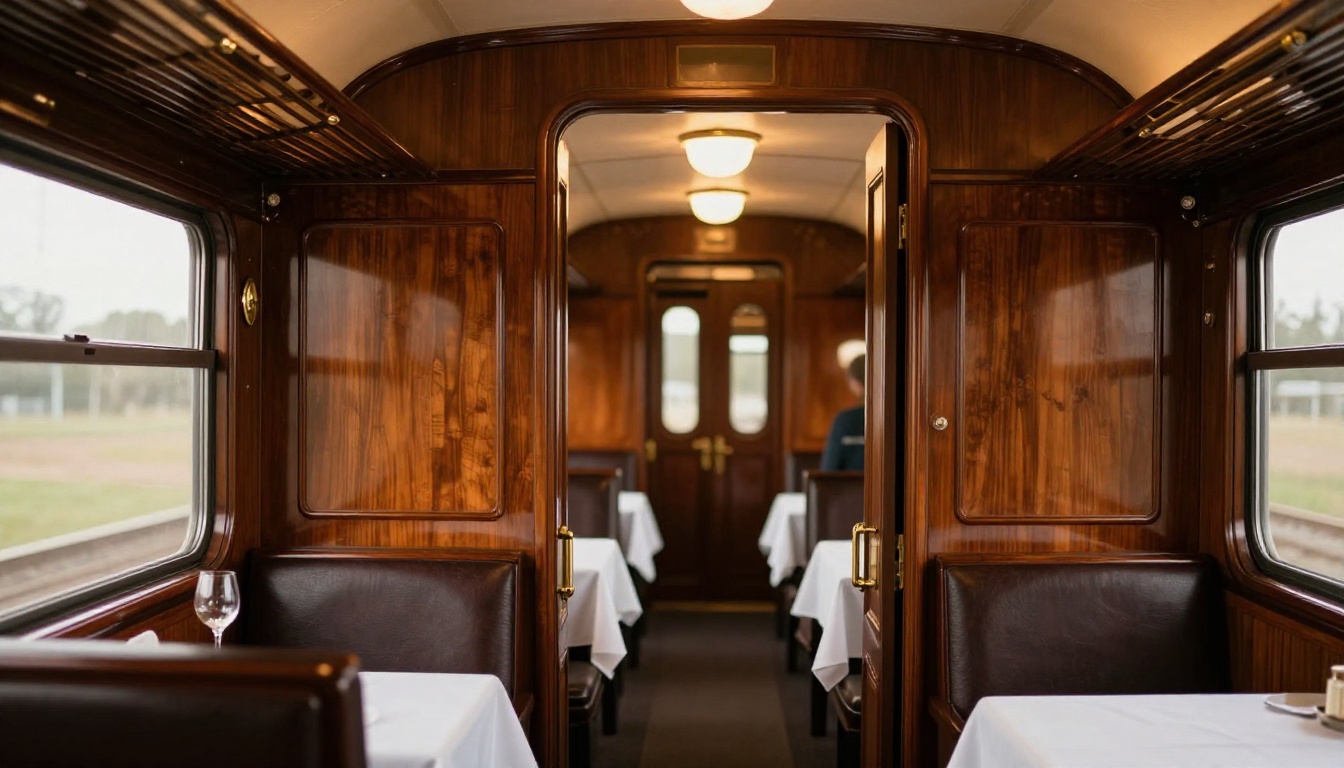
The Venice Simplon-Orient-Express runs from London to Venice in about thirty-one hours. A twin cabin on that route starts around $4,500 per person. For roughly the same money, you could fly business class to Venice, spend three nights at the Gritti Palace, eat at Quadri, and still have change left for a water taxi. The question is whether the train delivers something the flight-and-hotel combination cannot.
Sometimes it does. And sometimes you are paying $12,000 to sleep in a cabin the size of a closet while a pianist plays "As Time Goes By" in the bar car.
What You Are Actually Paying For
Luxury trains sell three things: scenery you cannot see from the air, a specific pace of travel that forces you to slow down, and a theatrical experience rooted in a pre-aviation era when trains were the only civilized way to cross a continent. The best ones deliver all three. The worst deliver theatre alone — a set dressed to look like the 1920s, served with adequate food and a heavy dose of nostalgia marketing.
The honest test is simple: would the route, the landscape, and the onboard experience justify the price if the train had launched last year with no heritage story? If the answer is yes, it is probably worth booking. If the entire appeal rests on Agatha Christie references and Art Deco marquetry, you should look more carefully at what the money actually buys.
Venice Simplon-Orient-Express: The Icon With Caveats
The is the train everyone pictures when they think of luxury rail travel. Belmond restored the original 1920s and 1930s carriages, and the result is genuinely beautiful — lacquered wood panelling by Rene Lalique, Fortuny fabrics, marquetry that took craftsmen months to restore. The bar car, with its black lacquer walls and baby grand piano, is one of the most photogenic interiors in travel.
The cabins are another matter. A Historic Cabin — the entry-level option at roughly $4,000-$6,000 per person depending on route and season — measures about 3.5 by 2 meters. The twin beds convert to a sofa for daytime, and a steward handles the transition. There is no en suite bathroom. You share lavatories at the end of the carriage, which are perfectly clean but not what most people expect when spending this kind of money.
The Grand Suite, introduced in the restored 2018 carriages, fixes the bathroom problem with a private en suite featuring a full-length shower. It also delivers a genuine living space — a sitting area, double bed, and room to move. Pricing starts around $8,000-$12,000 per person on the London-Venice route. This is where the VSOE experience actually matches the marketing.
Venice Simplon-Orient-Express: Cabin Classes
| Cabin Class | Price Per Person (London-Venice) | Size | Bathroom | Best For |
|---|---|---|---|---|
| Historic Twin | $4,000-$6,000 | 7 sqm | Shared | The experience once, checking the box |
| Cabin Suite | $6,500-$9,000 | 10 sqm | Private (compact) | Couples wanting privacy |
| Grand Suite | $8,000-$12,000 | 18 sqm | Private with shower | The way the train should be experienced |
| Paris-Istanbul (Grand) | $25,000-$35,000 | 18 sqm | Private with shower | Once-in-a-lifetime, ~6 nights |
The food is competent but not the reason to go. Dinner is a four-course French-influenced affair with decent wine pairings. It is good hotel restaurant cooking, not destination dining. Breakfast is continental. For what the ticket costs, the culinary ambition is surprisingly restrained — though the dining car itself, with its Lalique glass panels and starched white tablecloths, makes up for it atmospherically.
The honest verdict: The Historic Cabin is for people who want the story. The Grand Suite is for people who want the experience. There is a meaningful difference. If you can only afford the Historic Cabin, consider whether the same budget spent on a first-class flight and a great hotel would make you happier.
Rovos Rail: The One That Genuinely Justifies the Price
The out of Pretoria is, cabin for cabin, the best value in luxury rail travel. The Royal Suite — the top category — measures about 16 square meters, includes a full-size Victorian bathtub, a permanent double bed, and a private lounge area. It costs roughly $3,000-$5,000 per person for the two-night Pretoria to Cape Town journey, including all meals, drinks, and excursions.
For context, the VSOE charges more than that for a shared bathroom.
What Rovos does exceptionally well is the route itself. The Pretoria to Cape Town run crosses the Karoo — a vast, arid plain that most tourists never see — and stops at Matjiesfontein and Kimberley’s Big Hole along the way. The longer itineraries are even more compelling. The fifteen-day Dar es Salaam route covers 6,100 kilometers through South Africa, Botswana, Zimbabwe, Zambia, and Tanzania. The nine-day Namibia route runs through landscapes that look like another planet.
Rovos Rail: Key Routes Compared
| Route | Duration | Price Per Person (Royal Suite) | Highlights |
|---|---|---|---|
| Pretoria to Cape Town | 2 nights | $3,000-$5,000 | Karoo, Kimberley, winelands |
| Pretoria to Durban | 2 nights | $2,500-$4,500 | Drakensberg foothills, battlefields |
| Pretoria to Victoria Falls | 3 nights | $4,500-$7,000 | Hwange National Park, Zambezi |
| Pretoria to Dar es Salaam | 15 days | $15,000-$22,000 | Five countries, Great Rift Valley |
| Pretoria to Walvis Bay | 9 days | $10,000-$15,000 | Namibian desert, Sossusvlei |
The dining is also a genuine highlight. Rovos grows some of its own produce and sources South African wines that rival what you would find at top Cape Town restaurants. The menu changes daily. It is not Michelin cooking, but it is several tiers above what most luxury trains serve, and the wine list — heavy on Stellenbosch and Franschhoek estates — is generous by any standard.
The honest verdict: Rovos Rail is the luxury train where the experience consistently exceeds expectations. The cabins are larger, the routes more distinctive, the food more ambitious, and the pricing more reasonable than any European competitor. The trade-off is that you are in southern Africa, which may require a longer journey to reach. But if you are considering a high-end travel experience and rail appeals to you, this is where to start.
Belmond Royal Scotsman: Beautiful Train, Limited Route
The runs through the Scottish Highlands on itineraries ranging from two to seven nights, with prices starting around $4,000 per person for a short journey and climbing past $12,000 for the longer routes. The train carries just 36 guests in mahogany-panelled cabins with en suite bathrooms — small but private.
The appeal here is not the train itself, which is handsome but not spectacular. It is the Scottish Highlands seen at walking pace, with stops at distilleries, castles, and estates that would be difficult to string together by car in a coherent way. The whisky element is strong — several itineraries include private tastings at distilleries that do not normally accept visitors, and the onboard bar stocks single malts you would struggle to find outside Scotland.
The downsides are real. The cabins in the lower categories are tight — not VSOE-Historic-Cabin tight, but not generous either. The scenery, while beautiful, is the Scottish Highlands. You can rent a car, drive the same roads at your own pace, stay at Gleneagles or The Fife Arms, and experience the same landscapes for significantly less. The train’s advantage is convenience and curation — someone else has planned the route, arranged the distillery visits, and handled the logistics.
The honest verdict: The Royal Scotsman is best suited to people who specifically want to see the Highlands without driving and who value a structured itinerary. For independent travelers or whisky enthusiasts who already know what they want to visit, the self-drive option offers more flexibility at lower cost. The experience is pleasant but not transformative in the way Rovos can be.
Rocky Mountaineer: Scenery That Earns Its Price
The is a different proposition from the European heritage trains. There is no sleeping on board — the train runs during daylight hours only, with overnight hotel stays in Kamloops or Quesnel. It is a viewing experience, not a hotel-on-rails experience, and it should be judged accordingly.
There are two service levels. SilverLeaf, starting around $2,000-$2,800 per person for the two-day Vancouver to Banff route, seats you in a single-level dome car with oversized windows. GoldLeaf, at $3,500-$5,500, puts you in a bi-level glass-dome coach with a separate dining room downstairs and an open-air viewing platform. Both include meals, and the GoldLeaf food — think pan-seared salmon, Alberta beef tenderloin, and wines from the Okanagan — is legitimately good.
The scenery is the reason to go, and it delivers. The route through the Canadian Rockies — past Kamloops Lake, through the Spiral Tunnels, along the Kicking Horse River — is genuinely spectacular. There are stretches where the train runs through canyons with no road access, meaning the views are literally impossible to see any other way. That is a distinction few luxury trains can claim.
Luxury Train Comparison: Value for Money
| Train | Entry Price (Per Person) | Top Cabin (Per Person) | Bathroom | Route Distinction | Food Quality |
|---|---|---|---|---|---|
| VSOE (London-Venice) | $4,000 | $12,000 | Shared / Private | Moderate | Good, not exceptional |
| Rovos Rail (Pretoria-Cape Town) | $1,500 | $5,000 | Private, bathtub | High | Very good |
| Royal Scotsman | $4,000 | $12,000 | Private, compact | Moderate | Good |
| Rocky Mountaineer | $2,000 | $5,500 | Hotel overnight | High | Good to very good |
The honest verdict: The Rocky Mountaineer is not trying to be a luxury hotel on wheels. It is a front-row seat to some of the most dramatic mountain scenery on earth, with good food and professional service. At GoldLeaf prices, it offers strong value relative to the European trains. The catch is that you are not sleeping on the train — if the romance of a sleeper carriage is part of the fantasy, this is not that.
The Ones Selling Nostalgia You Can Get Cheaper
Not every luxury train merits the premium. A few that frequently appear on "best luxury trains" lists deserve a more honest assessment.
The Eastern and Oriental Express (now relaunched as the Eastern and Oriental Limited) runs between Singapore and Bangkok. The scenery through Malaysia is pleasant but not dramatic — rubber plantations, palm oil estates, and small towns. The cabins are attractive in a colonial-revival way but cramped. At $4,000-$8,000 per person for two nights, this is a train where the story does most of the heavy lifting. A business-class flight, two nights at Mandarin Oriental Bangkok, and dinner at Sorn would cost less and deliver more.
The Glacier Express in Switzerland is technically a luxury train, but the first-class "Excellence Class" at around $500-$600 for a single day trip from Zermatt to St. Moritz does not compete with the trains listed above. The scenery — crossing the Oberalp Pass, the Landwasser Viaduct — is wonderful. But the service is closer to a premium coach experience than genuine luxury. A Swiss Rail first-class ticket covers the same route for about CHF 150. The regular first-class cars have the same windows and views. You are paying $400 extra for a meal and a glass of champagne.
The Blue Train (South Africa, Pretoria to Cape Town) shares the same route concept as Rovos Rail but delivers a noticeably less polished experience. The cabins are comfortable but dated. The food is acceptable but lacks the ambition of Rovos. Pricing is similar or only slightly lower. There is no compelling reason to choose the Blue Train over Rovos unless Rovos is fully booked.
Practical Considerations
A few things that marketing materials consistently fail to mention.
- Motion and noise — Rail travel is not smooth. Even the best luxury trains sway, clatter over points, and occasionally brake hard enough to send a wineglass sliding. If you are a light sleeper, bring earplugs and expect interrupted sleep, particularly on European routes with frequent stops.
- Space constraints — Even the largest train cabins are smaller than the smallest hotel rooms. If you cannot tolerate close quarters for 24-48 hours, luxury rail may not suit you regardless of the price point.
- Booking lead times — The VSOE London-Venice route regularly sells out six to nine months ahead. Rovos is often booked a year in advance for peak-season departures. A concierge service can sometimes access cancelled reservations, but planning ahead is the reliable approach.
- Tipping — Most luxury trains include gratuities in the fare, but practices vary. On Rovos, tipping is not expected. On the VSOE, a discretionary cash tip to your cabin steward (EUR 50-100 per person) is customary. Check the tipping norms before boarding.
- Dress codes — The VSOE enforces a jacket-and-tie dress code for dinner. Rovos is similarly formal in the evening. The Rocky Mountaineer is smart casual. Pack accordingly — your cabin will not have much wardrobe space.
Where to Put Your Money
If this is your first luxury train experience, Rovos Rail offers the most for the money. The Royal Suite on the two-night Pretoria to Cape Town route costs less than a Historic Cabin on the VSOE and delivers a categorically better experience — private bathroom with bathtub, larger cabin, stronger food, and a route through terrain you would not otherwise see.
If the European itinerary matters to you, the VSOE is worth it at Grand Suite level. Below that, you are paying for bragging rights in an undersized cabin. Be honest with yourself about whether the story of having ridden the Orient Express is worth $5,000 to you. For some people it is. That is a legitimate reason — just not a travel one.
The Rocky Mountaineer is the smart choice for scenery-first travelers who do not need the sleeping-car romance. GoldLeaf class, a window seat, and the Canadian Rockies — that combination is hard to fault.
The best luxury trains justify their prices through routes you cannot replicate by road, cabins that feel like actual rooms, and food that goes beyond competent. When a train delivers all three, the premium makes sense. When it delivers only nostalgia, you are better served by a good hotel and a rented car.