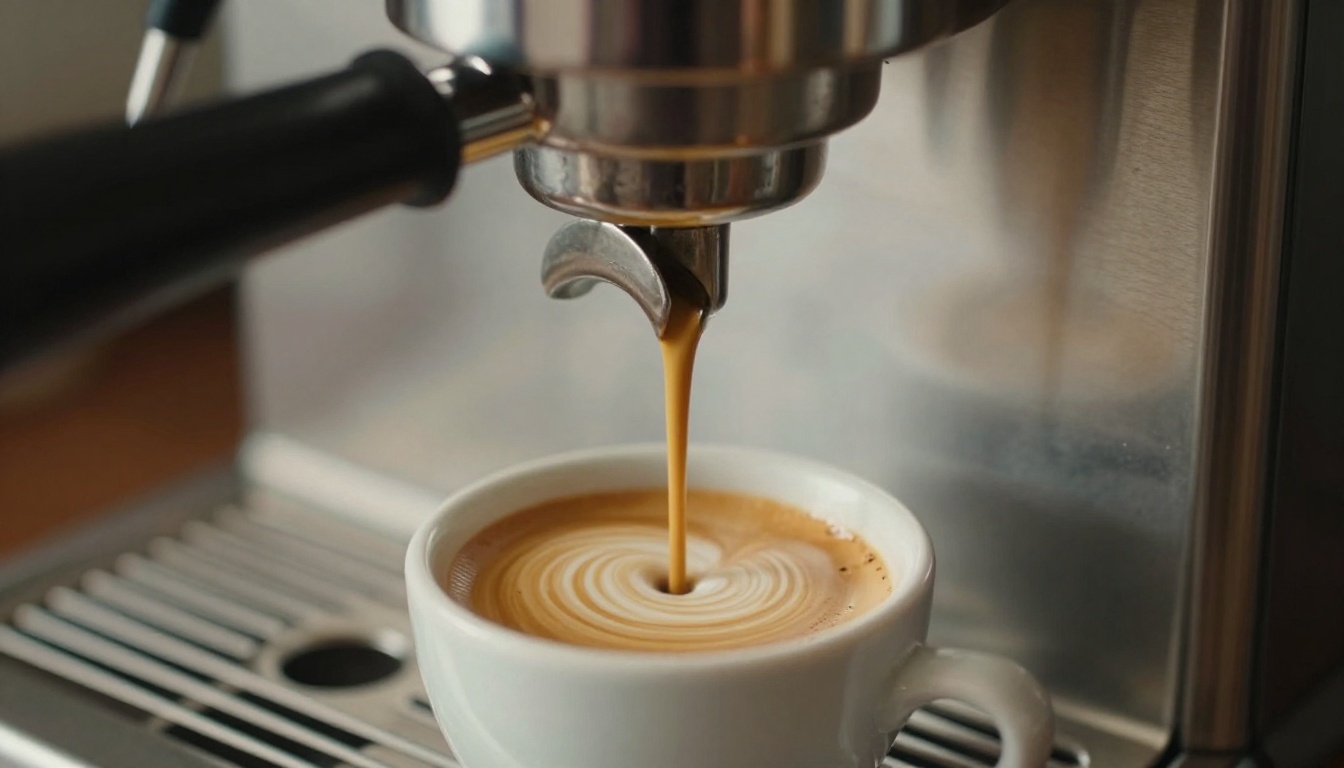
The $5,000 Espresso Machine Paradox
A La Marzocco Linea Mini sits on more kitchen counters than any other prosumer espresso machine. It weighs 29 kilograms. It has a dual-boiler system, a commercial-grade E61 group head, and a price tag that starts around $4,900. It also makes espresso that is, in many blind tastings, indistinguishable from what a $700 Breville Barista Express produces — assuming the person pulling the shot knows what they are doing and is using a capable grinder.
That last part is the quiet scandal of the home espresso world. The machine matters far less than most buyers think. The grinder matters more than almost anyone admits. And the water — the ingredient that makes up 90-plus percent of every shot — is barely discussed at all.
This is a breakdown of where money actually improves the coffee in your cup, where it buys thermal stability and build quality you may not need, and where the diminishing returns curve bends so sharply that spending more actively makes things harder.
What a Machine Actually Does to Your Espresso
An espresso machine has three jobs: heat water to the right temperature, hold it there consistently, and push it through the coffee puck at roughly 9 bars of pressure. That is it. Every other feature — PID controllers, pressure profiling, flow control, pre-infusion — is a refinement on those three basics.
The reason a $500 machine can produce a remarkable shot is that modern entry-level machines handle those three jobs adequately. A Breville Bambino Plus holds temperature within two or three degrees. A Lelit Anna with PID does even better. Neither has the thermal mass of a commercial machine, which means back-to-back shots may drift in temperature, but for a household pulling two to four drinks a morning, the difference is academic.
Where expensive machines earn their money is thermal stability under load and steam power. If you are making six milk drinks in a row — entertaining after dinner, for instance — a single-boiler machine forces you to wait between brewing and steaming. A heat exchanger like the solves that problem for around $1,800. A dual-boiler like the does it for $1,600 with better temperature accuracy, less visual flair, and none of the Italian romance.
The Grinder Is the Actual Investment
Here is the inconvenient truth that every serious barista and roaster will confirm: a $300 grinder paired with a $500 machine will outperform a $100 grinder paired with a $3,000 machine. Every time. Grind quality affects extraction uniformity, which affects flavor clarity, body, and sweetness more directly than any other variable in the chain.
The difference between a good grinder and a mediocre one is particle size distribution. Cheap blade grinders and low-end burr grinders produce a wide range of particle sizes — fines and boulders mixed together. The fines over-extract (bitter), the boulders under-extract (sour), and you get a muddled, ashy shot that no amount of machine engineering can fix.
Grinder Tiers and What They Deliver
| Grinder | Price Range | Burr Type | Best For |
|---|---|---|---|
| Baratza Encore ESP | $200 | 54mm conical | Budget espresso entry point |
| Eureka Mignon Notte | $300 | 50mm flat | Consistent daily espresso |
| Niche Zero | $700 | 63mm conical | Single-dosing, low retention |
| Eureka Mignon Specialita | $550 | 55mm flat | Excellent value, quiet |
| DF64 Gen 2 | $450 | 64mm flat | Modders and enthusiasts |
| Weber EG-1 | $3,500 | 83mm flat | Diminishing returns territory |
The sweet spot sits between $300 and $700. The has become the default recommendation in the specialty coffee community for good reason: 63mm conical burrs, near-zero retention, and a single-dose workflow that eliminates waste. The Eureka Mignon Specialita offers comparable grind quality in a more compact, timed-dosing format.
Above $700, improvements become marginal and taste-specific. Larger flat burrs produce a different flavor profile — cleaner, more transparent, less body — that some prefer. But the leap from a $700 grinder to a $3,500 one is nothing like the leap from a $100 grinder to a $300 one.
Water: The Variable Nobody Wants to Deal With
Espresso is roughly 93 percent water. The mineral content of that water determines how effectively it extracts soluble compounds from coffee, and it determines how quickly it scales and corrodes the internals of your machine. Hard water builds limescale. Soft water tastes flat and can leach metal from boilers.
The Specialty Coffee Association recommends water with a total dissolved solids (TDS) count between 75 and 250 ppm, ideally around 150. Most municipal tap water in North America and Europe falls within that range, but varies wildly by city and season. London tap water, for instance, runs around 300 ppm and will destroy a boiler in a few years without treatment.
The practical solutions, ranked by effort:
- BWT filter jug — Costs about $30 and softens water while adding magnesium for flavor. Requires filter replacement every four to six weeks. Good enough for most setups.
- In-line water filter — Machines with direct plumbing (like the Linea Mini) can use a BWT Bestmax or Pentair Everpure filter. Around $100-150 per year in replacement cartridges.
- Third Wave Water — Mineral packets added to distilled water. Gives you precise control over mineral content. More effort, consistent results. Around $15 for twelve gallons.
- DIY mineral recipes — The Barista Hustle protocol uses potassium bicarbonate and magnesium sulfate in distilled water. Costs pennies. Requires a gram scale and a willingness to measure.
Ignore water quality and you are optimizing everything downstream of the biggest variable. It is the equivalent of building a whisky collection and storing it in direct sunlight.
The Machines, Honestly Assessed
Under $500: Better Than You Think
The Breville Bambino Plus ($500) is the best value proposition in home espresso. It heats up in three seconds, produces consistent 9-bar pressure, and has an auto-steam wand that froths milk competently enough for latte art. Its integrated PID holds temperature well for a thermocoil system. Paired with a $300-500 grinder and decent water, it will produce shots that embarrass machines three times its price — provided you are comparing the coffee, not the chassis.
The trade-off is build quality. The Bambino is mostly plastic. It will not last fifteen years. But at $500, you could buy three of them over that period and still spend less than a single Linea Mini.
$1,000-$2,000: The Rational Sweet Spot
This is where dual-boiler machines live, and where the price-to-performance ratio peaks. The Breville Dual Boiler ($1,600) offers PID temperature control on both boilers, adjustable pre-infusion, and 58mm commercial portafilter compatibility. The Lelit Bianca ($1,700-$2,000) adds manual flow control via a paddle — a feature that lets you manipulate extraction pressure in real time, which matters if you enjoy the process as much as the result.
The sits at the far edge of this range ($3,500) and deserves special attention. It is a tablet-controlled machine that lets you program pressure, flow, and temperature profiles down to the second. It is also, frankly, ugly — a utilitarian black rectangle that looks like laboratory equipment. But it produces the most controllable espresso of any machine at any price, and its open-source community has generated thousands of replicable profiles for specific beans and roast levels. For the technically minded, nothing else comes close.
$3,000-$5,000: Countertop Furniture Territory
The is a beautiful machine. The chrome and stainless steel construction, the commercial E61 group head, the La Marzocco badge — it looks correct on a marble countertop in a way that a Breville never will. It is also overbuilt for home use. Its dual boilers are sized for a cafe environment. Its warm-up time is 20-25 minutes. Its weight makes it essentially permanent once placed.
Does it make better espresso than a Breville Dual Boiler? In controlled comparisons, the difference is negligible. What it offers is thermal consistency that never wavers, steam pressure that can texture milk in seconds, and a build quality that will likely outlast your kitchen. If those things matter to you — and for some people they genuinely do — the premium is defensible. But be honest about what you are paying for.
Machine Comparison: Price vs. What You Get
| Machine | Price | Boiler Type | Heat-Up Time | Best Feature | Biggest Trade-Off |
|---|---|---|---|---|---|
| Breville Bambino Plus | $500 | Thermocoil | 3 seconds | Value | Plastic build |
| Breville Dual Boiler | $1,600 | Dual boiler | 10 minutes | Temperature accuracy | Aesthetics |
| Lelit Bianca | $1,800 | Dual boiler | 15 minutes | Flow control paddle | Learning curve |
| Decent DE1 | $3,500 | Heated block | 3 minutes | Total control | Looks |
| La Marzocco Linea Mini | $4,900 | Dual boiler | 25 minutes | Build quality | Price per feature |
| Jura Z10 | $3,500 | Thermoblock | 1 minute | Convenience | No grind control |
Fully Automatic: A Different Category Entirely
Jura, De'Longhi, and Saeco make fully automatic machines that grind, tamp, brew, and froth milk at the press of a button. The Jura Z10 costs $3,500. The Jura S8 costs $2,000. They produce espresso-style drinks that are perfectly acceptable and require almost zero skill or effort.
They also produce espresso that is measurably worse than what a $500 semi-automatic with a good grinder delivers. The built-in grinders use small conical burrs with limited adjustment. The brewing chamber is pressurized in ways that mask grind deficiencies rather than reward precision. You cannot change the dose, the distribution, or the tamping pressure.
This is not a knock on fully automatic machines — it is a category distinction. If you want coffee that is better than a pod machine with no daily effort, a $1,200 Jura E6 is a reasonable choice. If you want espresso that rivals a specialty cafe, no fully automatic machine will get you there regardless of price. The same principle applies to smart home systems: convenience and quality often pull in opposite directions.
The Diminishing Returns Curve
Here is where spending makes the biggest difference, ranked by impact per dollar:
- Grinder ($0 to $500) — The single largest improvement you can make. Going from pre-ground coffee to a $300 burr grinder is the biggest quality leap in the entire chain.
- Fresh beans ($15-25/bag) — Specialty roasters shipping within two weeks of roast date versus supermarket beans is a profound difference. Budget $15-25 per 250g bag from a local roaster.
- Water treatment ($30-100) — A BWT filter or Third Wave Water packets. Small cost, measurable impact on clarity and sweetness.
- Machine ($500 to $1,600) — Going from a $200 steam-driven machine to a $500 pump machine matters. Going from $500 to $1,600 buys dual-boiler convenience. Going from $1,600 to $5,000 buys aesthetics and thermal mass.
- Accessories ($50-200) — A decent tamper, a WDT tool for distribution, a scale that reads to 0.1g. These cost little and improve consistency.
Notice the pattern. The first $500 spent on a grinder delivers more flavor improvement than the next $4,000 spent on a machine. This is the curve that manufacturers do not advertise, because it is hard to charge a premium for the advice "buy a better grinder and fix your water." It echoes the same diminishing returns question that comes up with high-end televisions.
When Expensive Actually Wins
There are scenarios where the premium machine is the right call. If you entertain frequently and pull ten or more drinks in a session, thermal stability under load becomes a real factor, not a theoretical one. If you plan to keep the machine for a decade or more, La Marzocco's build quality and parts availability are genuine advantages — their commercial machines run in cafes for twenty years.
If you care deeply about milk texture, commercial-grade steam boilers produce dry, powerful steam that creates microfoam faster and more consistently than any entry-level machine. For someone making three or four oat milk flat whites every morning, the steam system alone might justify moving from a Bambino to a Bianca.
And if you simply want a piece of equipment that feels enduring — something made from machined steel and brass that sits on your counter like it belongs there — that has value too. Not every purchase needs to survive a blind taste test to be worthwhile.
The Honest Recommendation
For most people making espresso-based drinks at home, the rational setup is a Breville Bambino Plus ($500), a Eureka Mignon Specialita or Niche Zero ($550-$700), a BWT filter jug ($30), and fresh beans from a local roaster ($20/bag). Total: around $1,100. This combination, in the hands of someone willing to learn basic technique, will produce espresso that is better than 90 percent of what cafes serve.
For the enthusiast who wants process control and does not care about aesthetics, the Decent DE1 ($3,500) with a Niche Zero and Third Wave Water is the most capable home setup at any price. For the person who wants their kitchen to look a certain way and has the budget to match, the Linea Mini is a reasonable choice — just pair it with a proper grinder and do not expect the espresso itself to taste $4,000 better than the budget setup.
The best home espresso setup is not the most expensive one. It is the one where no single component is drastically weaker than the others. A $5,000 machine with a $50 grinder is a $50 espresso system.
Spend where it matters. The coffee does not care what the machine looks like.
Looking for luxury brands, stores, and services? Browse our curated directory: