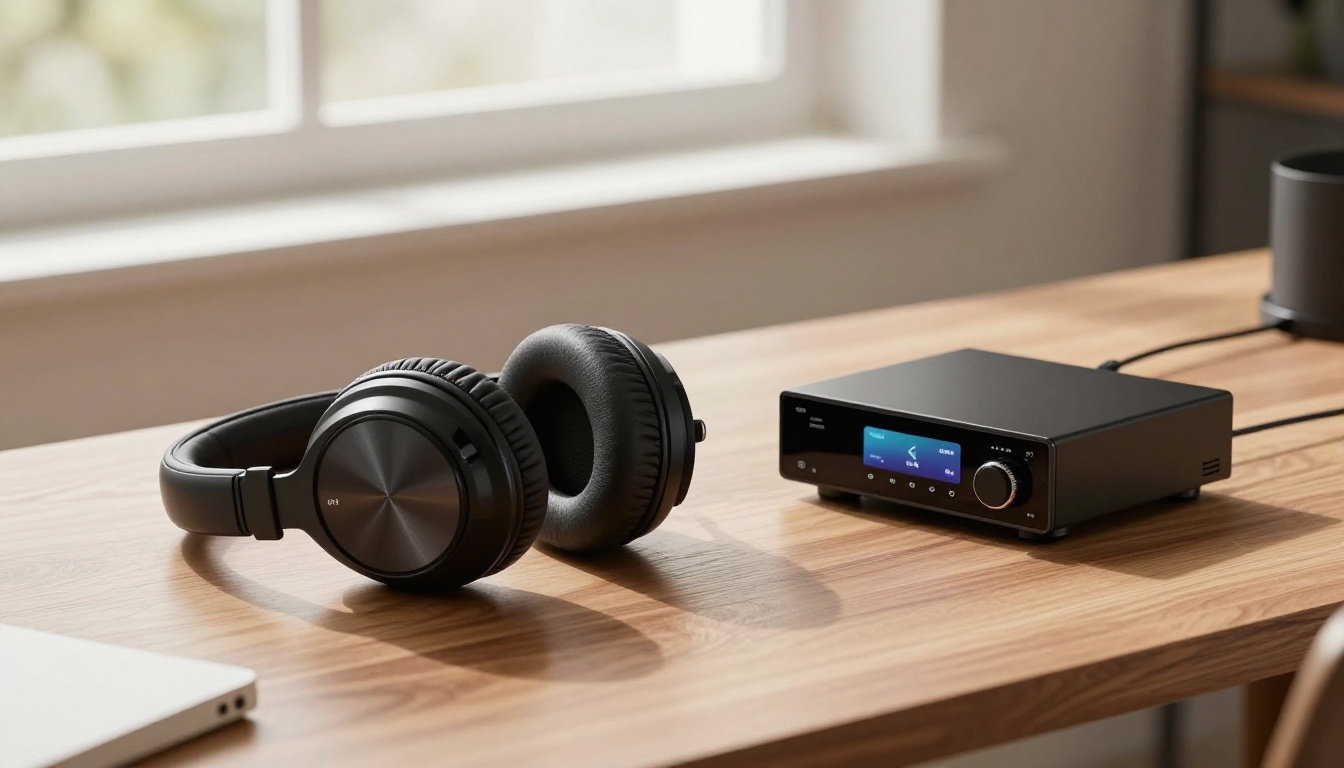
A pair of headphones places the music a few millimeters from your eardrum. There is no listening room, no first-reflection point, no bass mode booming at one seat and vanishing at the next. That single fact explains why a well-assembled headphone rig can reach reference-level sound for a fraction of what an equivalent loudspeaker system costs, and why some of the people who can afford anything choose to listen this way.
The trade is real and worth stating up front. Headphones collapse the soundstage into your skull, they isolate you from everyone else in the room, and they cannot move air across your chest the way a good floorstander does. But for resolution per dollar, for late-night listening, and for anyone whose room fights them at every turn, the case is strong. This is a companion to the argument that a proper home audio setup turns Spotify into a concert hall and to the question of whether a turntable setup justifies five figures — same obsession, different delivery.
Why the Room Is the Hidden Cost of Speakers
Loudspeaker sound is a negotiation with architecture. Bass frequencies build standing waves between parallel walls, hard surfaces smear detail, and the distance between you and each driver changes the tonal balance. Reviewers who measure rooms routinely find swings of fifteen decibels or more in the bass before any treatment goes in. Correcting that means acoustic panels, bass traps, careful speaker placement, and often a digital room-correction processor — costs that arrive before the speakers themselves justify their price.
Headphones sidestep nearly all of it. The driver sits in a fixed relationship to the ear, the same in a Manhattan apartment as in a hotel room. What you hear is overwhelmingly the transducer and the electronics feeding it, not the building you happen to be in. That is why a four-figure headphone can compete on detail retrieval with a loudspeaker system costing ten times as much, and why the comparison to a $50,000 rig is not marketing hyperbole but a fair accounting of what each dollar buys.
The honest limit is spatial. Speakers throw a soundstage in front of you, with width and depth your ears interpret as a real acoustic space. Headphones, lacking the crosstalk and room reflections that cue spatial hearing, tend to place the image inside your head. Crossfeed circuits and head-tracking spatial processing narrow the gap, but they do not close it. If recreating the geometry of a concert hall matters more than anything, speakers still win.
The Signal Chain, and Where Spend Actually Goes
A headphone rig is three components in series: a digital-to-analog converter, a headphone amplifier, and the headphones. The source — a streamer, a laptop, a CD transport — feeds digital audio to the DAC, which reconstructs the analog waveform. The amplifier then provides the voltage and current to drive the headphones, and the headphones convert that signal to sound. Get the order of priority right and the budget allocates itself sensibly.
The headphones matter most. They are the transducer, the part that physically makes sound, and no upstream component can add detail a mediocre driver fails to resolve. The amplifier matters next, particularly with demanding loads. The DAC matters least in the sense that competent conversion is now inexpensive — though the best units still extract a last layer of texture that careful listeners hear.
Driver types, and what each one does well
Three driver technologies dominate the high end. Dynamic drivers, the familiar cone-and-voice-coil design, deliver weight and slam and are the easiest to drive. Planar magnetic drivers stretch a thin diaphragm across an array of magnets, producing fast, low-distortion bass and a flat frequency response, at the cost of needing more power. Electrostatic drivers use a charged film suspended in an electric field, offering the lowest distortion and the fastest transients of any design — but they require a dedicated high-voltage energizer rather than a normal amplifier.
Sennheiser, Focal, and Audeze anchor the dynamic and planar camps, while Stax has built electrostatics for decades. The reputational shorthand is worth knowing: is known for dynamic clarity and a forward, detailed presentation; for planar slam and a thicker tonal weight; and for a neutral, reference voicing that has defined the category for thirty years.
Specifications matter more here than in most audio gear. Impedance, measured in ohms, tells you how hard a headphone is to drive — a 300-ohm dynamic and a 32-ohm planar can both be hard to power well, for different reasons. Sensitivity tells you how loud a headphone plays per unit of power. The pairing of amplifier to headphone is not optional: an underpowered amp leaves a capable headphone sounding flat and dynamically compressed, which is the most common mistake new owners make.
The case for balanced output
Higher-end rigs increasingly run balanced rather than single-ended connections. A balanced output carries the signal on two opposite-polarity conductors per channel, which doubles available voltage swing and cancels common-mode noise. The audible benefit is usually a lower noise floor and more effortless dynamics on power-hungry headphones, rather than a night-and-day tonal change. It is a real advantage at the top of the range and largely irrelevant at the entry level.
Four Tiers, From Capable to End-Game
The following pairings represent coherent rigs at each level — matched amplifier, DAC, and headphone rather than a single splashy component bolted to weak supporting gear. Prices are approximate and reflect current street pricing reported by retailers and reviewers.
Matched headphone rigs by tier
| Tier | Headphone | DAC / Amp | Driver type | Approx. total |
|---|---|---|---|---|
| Entry reference | Sennheiser HD 600 | Chord Mojo 2 | Dynamic, 300 ohm | $1,000 |
| Serious | Focal Clear MG | Chord Hugo 2 | Dynamic, 55 ohm | $4,500 |
| Reference | ZMF Caldera | Dan Clark Audio Stealth + desktop amp | Planar | $9,000 |
| End-game | Stax SR-X9000 | Stax electrostatic energizer | Electrostatic | $15,000+ |
The entry-reference tier is where the value argument bites hardest. A neutral dynamic headphone fed by a competent portable DAC/amp delivers most of what reference sound is about — accurate tone, clean detail, honest dynamics — for around a thousand dollars. Owners and reviewers consistently note that the jump from here to the next tier is real but proportionally smaller than the price increase suggests.
The serious tier adds resolution, build quality, and the kind of refinement that rewards long listening. amplifiers and DACs are a common destination here, prized for a clean, slightly forward signature and genuinely portable form factors that still drive demanding headphones. A Focal dynamic at this level competes directly with loudspeaker systems several times its cost on detail and timbre.
The reference tier is where planar magnetic designs and boutique builders take over. hand-builds wooden-cup planars and dynamics in Chicago, voiced for musicality rather than clinical flatness; and push planar engineering toward the lowest distortion measurements in the category. These headphones demand real desktop amplification, and the supporting electronics now cost as much as the headphones.
The end-game tier is electrostatic territory. systems require their own energizer and cannot be run from a conventional amp, which is why they are quoted as a system rather than a headphone. The reward is transient speed and a transparency that many long-time listeners consider the closest thing to hearing the master tape. Whether the last few thousand dollars buys an audible improvement or a philosophical one is exactly the question this tier raises.
Total rig cost by tier
Where Spend Stops Mattering
Diminishing returns arrive early and steeply in headphones. The gap between a $200 headphone and a $1,000 one is large and obvious to almost anyone. The gap between a $1,000 rig and a $4,500 one is real but requires attentive listening on good recordings. Beyond roughly the reference tier, improvements become a matter of preference, last-percent resolution, and the pleasure of owning hand-built objects — not a linear climb in fidelity.
Cables are where the most money evaporates for the least return. A properly engineered headphone cable should be inert; replacing a competent stock cable with a thousand-dollar aftermarket one has never been shown to change the sound in controlled listening. Connector quality and length matter for practicality. The metallurgy mythology does not. Spend there only if the ergonomics or aesthetics justify it on their own terms.
The headphone that resolves more detail than your room ever will costs less than the acoustic treatment a comparable speaker system requires. That is the whole argument, and it holds.
Two practical points decide whether a headphone rig is right for a given listener. First, headphones are solitary by design — they exclude the room and everyone in it, which is either the appeal or the deal-breaker. Second, the format you feed them matters as much as it does anywhere in high fidelity; a reference rig exposes a bad recording mercilessly, the same way a $25,000 television reveals a poor source. Lossless streaming and well-mastered files are the price of entry.
For the listener who values resolution over spectacle, who lives somewhere a loudspeaker system would never sound right, or who simply wants reference sound without rebuilding a room around it, the headphone rig is not a compromise. It is the more direct path to the same destination — and on the math of dollars per unit of fidelity, it is the more rational one.